






Quick Answer: Progressive jackpot slots are games where the top prize grows every time someone plays, because a small percentage of each wager is added to a shared pool instead of a fixed payout. The jackpot keeps climbing until one player triggers it, then it resets to a base amount and starts growing again.
Introduction
Here’s something most beginners don’t realize: a progressive jackpot slot showing a prize of $2.4 million didn’t start that way. It started at a base number — often just a few thousand dollars — and grew one spin at a time, fed by thousands of players across a network of machines. That’s the entire concept behind progressive jackpot slots, and it’s also why the mechanics confuse so many new players.
Unlike a standard slot machine with a fixed top prize, a progressive jackpot slot links its biggest payout to a constantly shifting number that only goes up until someone hits it. In this guide, you’ll learn how these jackpots are funded, how the odds actually work, what separates them from regular slots, and which mistakes trip up most first-time players. By the end, you’ll understand the mechanics well enough to read any progressive slot’s paytable with confidence.
What Are Progressive Jackpot Slots (And Why Beginners Struggle With Them)
A progressive jackpot slot is a game where the top prize increases continuously instead of staying fixed. Every time a player makes a wager, a small portion of that bet is diverted into a growing jackpot pool. That pool climbs with every spin, across every player connected to it, until someone lands the winning combination and claims it.
The confusion usually starts here: beginners assume the displayed jackpot number is somehow tied to the specific machine they’re playing. In reality, most progressive jackpots are shared across many machines, sometimes across many different locations or platforms entirely. The number you see ticking upward reflects the combined activity of everyone contributing to that pool, not just your own play.
This shared-pool structure is also what makes progressive jackpots fundamentally different from a game’s regular payout table. A standard win comes from your own spin outcome, calculated against fixed odds. A jackpot win comes from a separate, layered system running in parallel, and that layered structure is precisely what trips up new players trying to understand their odds.
How Progressive Jackpots Actually Work (The Mechanics)
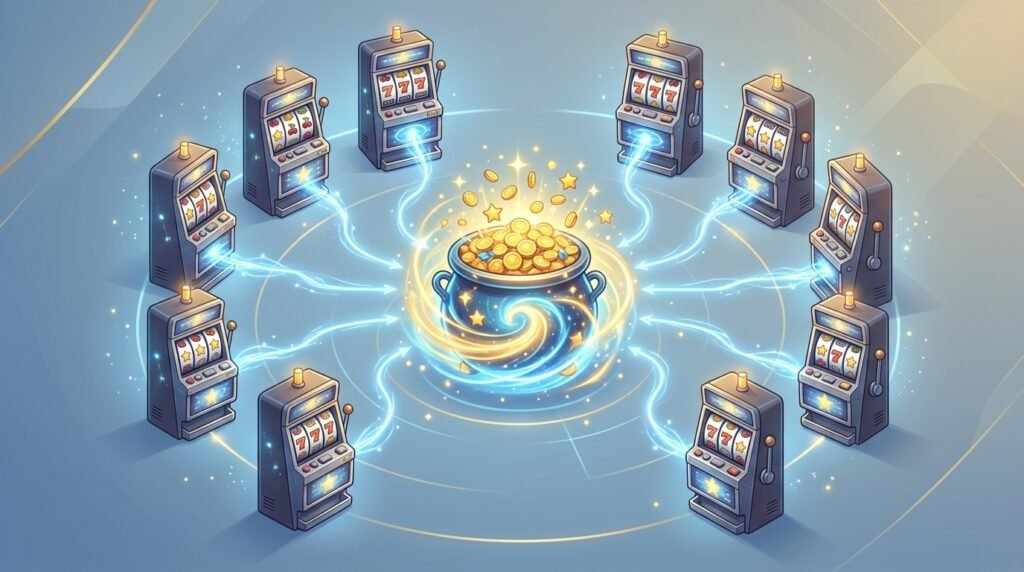
To understand progressive slots, it helps to break down the mechanism into its core parts:
- The contribution rate. A fixed, small percentage of every wager — often less than 1% — is set aside and added to the jackpot pool rather than paid out as a regular win.
- The pool aggregation. That contribution is combined with contributions from every other player on the same jackpot network, whether that’s one machine or thousands.
- The seed amount. After a jackpot is won, it doesn’t reset to zero. It resets to a predetermined “seed” value, which is the minimum guaranteed starting point for the next growth cycle.
- The trigger condition. Winning the jackpot usually requires landing a specific symbol combination, though some games trigger it randomly regardless of your bet outcome on that spin.
- The payout structure. Once triggered, the jackpot pays out either as a lump sum or, for very large prizes, in structured installments over time.
Because the contribution rate is fixed and the trigger condition is rare by design, the jackpot has room to climb for a long time before it’s claimed. This is also why progressive jackpots can sit at modest values for weeks and then suddenly spike into the millions — the pool simply hasn’t been triggered yet.
Rules Explained Step-by-Step
If you’re trying to understand progressive slots as a beginner, it helps to walk through the process in order:
- Find the jackpot indicator. Most progressive slots display the current jackpot amount directly on the game screen, often above the reels.
- Check the eligibility requirements. Some progressive jackpots only activate if you’re wagering the maximum bet amount — this detail is usually buried in the paytable.
- Understand the trigger mechanism. Read whether the jackpot is won through a specific symbol pattern, a bonus round, or a random trigger.
- Note the jackpot tiers. Many progressive games have multiple jackpot levels (mini, minor, major, grand), each with different odds and different payout sizes.
- Track the growth pattern. If a platform shows jackpot history, you can see how quickly it grows and how recently it was last triggered.
Pro Tip: Always check whether a jackpot requires a maximum bet to qualify. Some games technically let you play for the base game at any wager, but silently exclude you from jackpot eligibility unless you’re betting at the top tier.
Common Beginner Mistakes to Avoid
New players tend to make the same handful of errors when they first encounter progressive jackpot slots:
- Assuming the jackpot is machine-specific. Most progressive jackpots pool contributions from many machines or players, not just the one you’re sitting at.
- Ignoring the max-bet requirement. Missing this detail means you could be playing without any chance at the top prize, even if you’re wagering consistently.
- Confusing jackpot odds with base game odds. The odds of triggering a jackpot are separate from — and usually far longer than — the odds of landing a regular winning combination.
- Expecting jackpots to reset to zero. Progressive jackpots reset to a seed value, not zero, which is why the displayed number never drops to nothing after a win.
- Overlooking jackpot tiers. Treating a “mini” jackpot the same as a “grand” jackpot leads to unrealistic expectations about frequency and size.
Terms and Terminology Explained
Progressive slot terminology can feel like a foreign language at first. Here are the terms you’ll run into most often:
- Seed amount: The fixed minimum value a jackpot resets to after being won.
- Contribution rate: The percentage of each wager funneled into the jackpot pool.
- Standalone progressive: A jackpot tied to a single machine, growing only from that machine’s own wagers.
- Networked (or linked) progressive: A jackpot shared across multiple machines, often across different locations.
- Wide-area progressive: A large-scale networked jackpot spanning many venues or platforms simultaneously, which explains why these prizes can grow so large.
- Jackpot tiers: Multiple prize levels within one game, ranging from small, frequent payouts to rare, massive ones.
- RTP (Return to Player): A theoretical long-term payout percentage that, for progressive slots, is often calculated separately for the base game and the jackpot pool.
Strategy and Tips for Better Understanding
Even though progressive jackpots are governed by randomness, understanding a few structural details helps you read the game more clearly:
- Read the paytable in full before forming assumptions. Jackpot rules, eligibility, and tier structures are always listed there, even if the layout hides them among smaller text.
- Compare seed amounts across similar games. A higher seed amount generally means a larger base contribution pool, which can indicate a different long-term growth pattern.
- Understand that jackpot size doesn’t reflect “how close” a trigger is. A jackpot at $3 million isn’t statistically closer to being won than one at $300,000 — the growth number and the trigger probability are independent of each other.
- Recognize the difference between fixed and random triggers. Games with random triggers award the jackpot without needing a specific symbol combination, which changes how you interpret near-misses.
Pro Tip: Never judge a progressive jackpot’s fairness by its current size. A jackpot’s dollar amount tells you how long it’s been growing, not how likely it is to hit on your next spin.
Myths vs. Facts
| Myth | Fact |
|---|---|
| A jackpot is “due” after growing for a long time | Each spin’s outcome is independent; growth duration doesn’t affect trigger probability |
| Bigger jackpots mean better odds | Jackpot size and jackpot odds are separate variables entirely |
| You always need to bet real money to see how jackpots work | Many platforms let you view jackpot mechanics and paytables without wagering |
| Progressive jackpots reset to zero after a win | They reset to a fixed seed value, not zero |
| All progressive slots work the same way | Standalone, networked, and wide-area progressives all follow different structures |
Progressive Jackpot Types Compared
| Type | Growth Source | Typical Size | Best For Understanding |
|---|---|---|---|
| Standalone progressive | Single machine only | Small to moderate | Learning basic mechanics |
| Networked progressive | Multiple machines, one location or platform | Moderate to large | Seeing pooled contribution effects |
| Wide-area progressive | Many machines across multiple venues/platforms | Very large | Understanding large-scale jackpot growth |
Conclusion
Progressive jackpot slots come down to three core ideas: the jackpot grows because a small share of every wager feeds a shared pool, that pool resets to a seed value rather than zero once triggered, and the size of the jackpot has no bearing on how close it is to being won. Once you separate these mechanics from the randomness of the base game, the whole system becomes far less mysterious.
So the next time you see a progressive jackpot ticking upward on a screen, what do you think is really happening behind that number? If you want to go deeper, a natural next step is learning how RTP is calculated for slot games in general, since it explains the math underneath both the base game and the jackpot layer.
Understanding the mechanics doesn’t just satisfy curiosity — it’s the difference between reading a paytable and actually understanding it.
FAQs
How do progressive jackpot slots work?
Progressive jackpot slots work by collecting a small percentage of every wager placed and adding it to a shared prize pool. This pool grows continuously across all connected players until someone triggers the winning combination or condition. Once won, the jackpot resets to a fixed seed value and begins growing again from that baseline, rather than starting over from zero.
What is a progressive jackpot slot machine?
A progressive jackpot slot machine is a slot game connected to a growing prize fund instead of a fixed top payout. The jackpot can be tied to just one machine, a group of machines, or a wide network spanning multiple platforms. Its defining feature is that the top prize increases with play, funded by ongoing player contributions.
Do you need to bet max to win a progressive jackpot?
In many progressive jackpot slots, yes — eligibility for the jackpot often requires wagering the maximum bet amount, even though the base game can be played at lower stakes. This requirement isn’t always obvious, so it’s worth checking:
- The game’s official paytable
- Any eligibility notes near the jackpot display
- The rules section, which usually clarifies bet-size requirements
Why do progressive jackpots grow so large?
Progressive jackpots grow large because they pool contributions from many players over time, sometimes across many machines or locations simultaneously. The longer a jackpot goes without being triggered, the more contributions accumulate, which is why wide-area progressive jackpots can reach amounts far beyond what a single machine could generate alone.
What happens after someone wins a progressive jackpot?
After a progressive jackpot is won, the prize pool doesn’t disappear entirely — it resets to a predetermined seed amount, which is the minimum starting value for the next growth cycle. From there, the jackpot begins climbing again as new contributions are added, following the same cycle as before.
Are progressive jackpot slots different from regular slots?
Yes, progressive jackpot slots differ from regular slots because they layer a separate, growing prize pool on top of the base game’s normal payout structure. Regular slots pay fixed amounts based on their built-in paytable, while progressive slots add an additional, expanding jackpot that depends on collective player activity rather than a single spin’s outcome.