





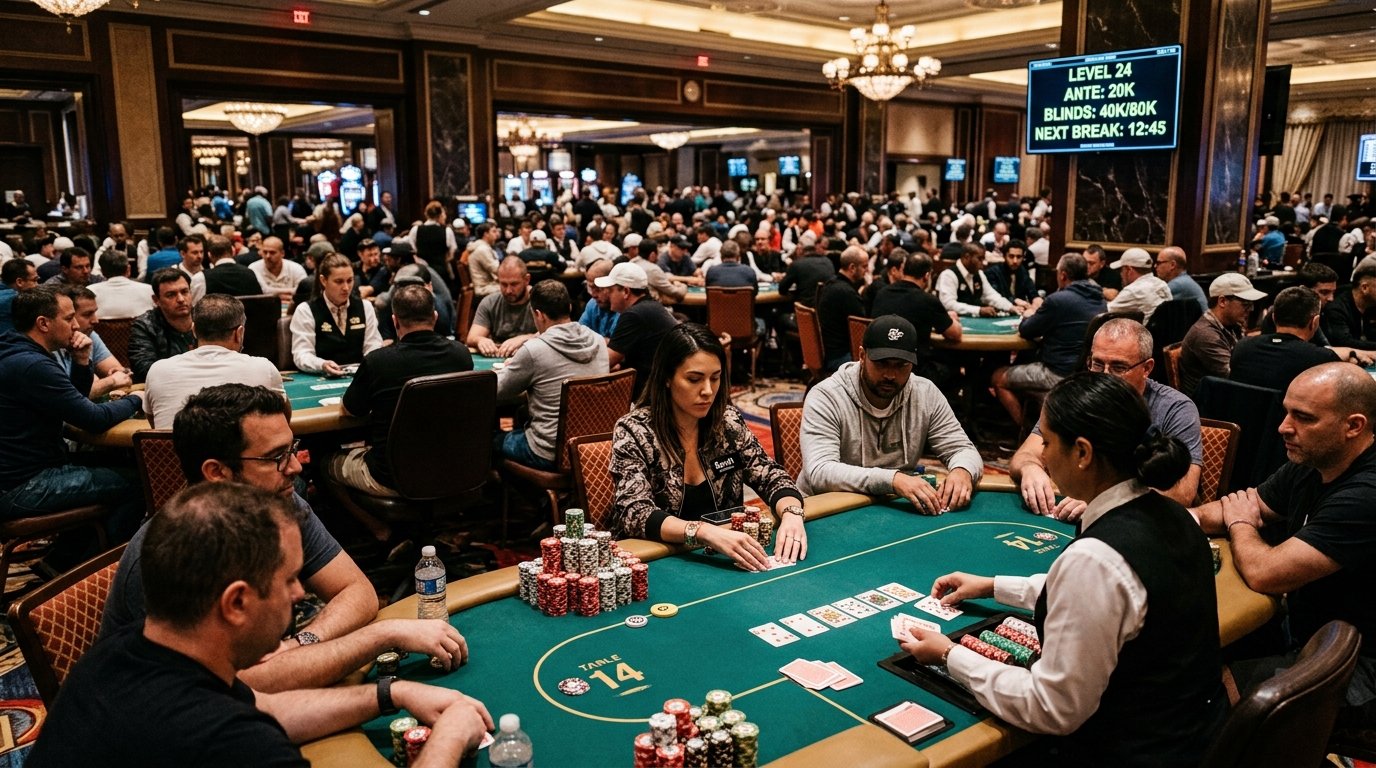
Quick Answer: Poker tournaments near you are structured events where players pay a fixed entry, receive equal starting chips, and play until one person holds all the chips. Unlike cash games, blinds rise on a set clock, and once you’re out of chips, you’re out of the tournament — there’s no rebuying your seat back.
Nine out of ten first-time tournament players make the same mistake before they even sit down: they walk in expecting a cash game with a fancier name. It isn’t. Poker tournaments near me searches spike every weekend as casual players decide they’re ready to test their skills against a room full of strangers, but almost none of them understand the structural differences until chips are already flying. By the end of this guide, you’ll know exactly how a tournament is built, what the blind structure means for your strategy, which mistakes send beginners home early, and how to judge whether a local event is actually worth your time and buy-in.
This isn’t a promotional rundown of where to play. It’s a breakdown of the mechanics — the blind levels, the payout structures, the terminology — so that when you do walk into a local room or card club, you’re not the person asking what “the button” means.
What Are Poker Tournaments — And Why Beginners Struggle With Them
A poker tournament is a competition where every entrant pays a fixed fee (called a buy-in) in exchange for an equal stack of tournament chips. Those chips have no cash value outside the event — they’re a scorekeeping tool, not currency. Play continues, table by table, until one player has won every chip on the felt.
Beginners struggle here for one core reason: cash game instincts don’t transfer cleanly. In a cash game, chips equal dollars, and you can reload whenever you bust. In a tournament, your stack is finite, blinds climb whether you’re ready or not, and survival itself is a skill. A player who is merely “good at poker” but unfamiliar with tournament pacing will often make cash-game-style decisions — like calling a big raise “to see a flop” — that are simply too expensive once blinds have escalated.
The Rules, Step by Step
Tournament structure sounds complicated until you see it broken into stages. Here’s the sequence almost every event follows:
- Registration and seating — Players register in advance or on the day, and a random draw assigns starting seats across multiple tables.
- Starting stack distribution — Every player receives the same number of tournament chips, regardless of buy-in amount paid (some events offer optional add-ons for extra starting chips).
- Blind levels begin — Small and big blinds start low and increase at fixed intervals (often every 15–30 minutes).
- Table balancing — As players bust out, tournament staff move remaining players between tables to keep seat counts even.
- Antes kick in — At later levels, every player at the table contributes a small forced bet on top of the blinds, speeding up the action.
- The bubble — This is the stage right before payouts begin, where players are most cautious because busting here means finishing with nothing.
- Final table — The remaining handful of players (usually 6–10) play at one table for the bulk of the prize pool.
- Heads-up finish — The tournament ends when one player has won every chip from the last remaining opponent.
Pro Tip: Ask organizers for the exact blind structure sheet before you sit down. Knowing how fast blinds climb tells you how aggressive you’ll need to play in the middle stages.
How the Tournament Clock Actually Drives Strategy
The single biggest mechanical difference from a cash game is the clock. Because blinds rise on a schedule regardless of how big or small your stack is, your relative chip stack shrinks over time even if you’re not losing hands. This is usually measured in “big blinds” — if you have 20 big blinds, you have room to maneuver; if you’re down to 8, you’re in shove-or-fold territory.
This mechanic is why tournament poker rewards patience early and controlled aggression later. In the opening levels, blinds are small relative to stacks, so mistakes are cheaper and players can afford to see more flops. As levels climb, that luxury disappears — every decision carries more weight because rebuilding a stack from mid-hand becomes dramatically harder.
Common Beginner Mistakes to Avoid
- Playing too many hands early — Just because chips feel “free” in reference to their cash value doesn’t mean they’re replaceable once gone.
- Ignoring stack sizes relative to blinds — A stack that felt comfortable at Level 1 can be critically short by Level 6 if blinds have tripled.
- Limping instead of raising — Passive entries into pots invite multiple opponents and reduce your ability to control the hand.
- Forgetting the bubble exists — Overly loose play right before the money stage can end a tournament that was otherwise going well.
- Not tracking table image — New players often forget that opponents are watching patterns just as closely as they’re watching cards.
Tournament Terminology Explained
Understanding the vocabulary makes the whole experience less intimidating:
- Buy-in — The entry fee required to receive your starting chip stack.
- Blinds — Forced bets posted by two players before cards are dealt, increasing at set intervals.
- Ante — A small forced contribution from every player at the table, added at later stages.
- Bubble — The point in the tournament immediately before the paying positions begin.
- ITM (In The Money) — A player who has finished in a paying position.
- Short stack — A player with a low chip count relative to the current blind level.
- Re-entry — In some formats, a busted player may pay again to re-enter before a certain cutoff level.
Strategy Tips for Understanding Tournament Play

Tournament decision-making is less about individual hands and more about stack preservation across stages. A few concepts worth understanding before you play:
- Stack-to-blind ratio matters more than raw chip count. Ten thousand chips means very different things at Level 2 versus Level 10.
- Position becomes more valuable as tables shrink. With fewer players, acting last happens more often, and that informational edge compounds.
- Survival has value. Outlasting a portion of the field to reach a paying position is itself a legitimate goal, separate from chasing the top prize.
Pro Tip: Many local tournament rooms post average stack sizes on a screen or leaderboard during play — checking this regularly helps you calibrate how aggressive or conservative you should be relative to the field.
Myths vs. Facts About Poker Tournaments
Myth: Bigger buy-ins mean better structures for beginners. Fact: Some lower buy-in events actually have slower blind increases, giving new players more time to make decisions without rushing.
Myth: You need to play every hand aggressively to survive. Fact: Patience in early levels, followed by calculated aggression as blinds rise, is the more common winning pattern.
Myth: Tournaments and cash games use the same optimal strategy. Fact: Cash game strategy assumes unlimited rebuys; tournament strategy must account for a finite, non-replenishable stack and a rising cost of blinds.
Myth: Once you’re seated, the format stays the same all night. Fact: Blind levels, table sizes, and even antes change throughout the event — the “rules” of the moment are constantly shifting.
Comparing Common Tournament Formats
| Format | Starting Stack | Blind Speed | Best For Beginners? |
|---|---|---|---|
| Freezeout | Fixed, no rebuys | Standard (15–20 min levels) | Moderate — no second chances |
| Re-entry | Fixed, rebuy allowed before cutoff | Standard | Yes — forgiving of early mistakes |
| Turbo | Fixed | Fast (5–8 min levels) | No — too little time to adjust |
| Deep Stack | Higher than standard | Slower | Yes — more room to learn as you play |
| Satellite | Fixed | Varies | Moderate — prize is entry to a bigger event, not cash |
Conclusion
Understanding poker tournaments near you starts with recognizing three things: chips are finite and non-cash, blinds rise on a fixed clock that shapes every decision, and survival through stages like the bubble is a skill of its own, not luck. Once those mechanics click, the terminology and structure of any local event stop feeling like a foreign language.
So the next time you search for a tournament nearby, what will you check first — the blind structure, the format, or the starting stack size? If you’re still shaky on hand rankings or betting rounds, a guide on core poker rules for beginners is a solid next read.
Tournaments reward the players who understand the clock, not just the cards.
FAQs
What are poker tournaments near me, and how are they different from cash games?
Local poker tournaments involve a fixed buy-in, equal starting chip stacks, and rising blinds on a set schedule. Unlike cash games, chips represent tournament standing rather than direct cash value, and once your stack is gone, your tournament ends — there’s no simply buying back in during most formats.
How long do local poker tournaments usually last?
Duration depends heavily on structure and field size. A small local event might wrap in 2–3 hours, while larger multi-table tournaments with hundreds of entrants can run 8+ hours across multiple sessions, sometimes over more than one day.
What should I expect at my first poker tournament?
Expect: (1) a random seat draw at registration, (2) an equal starting stack regardless of buy-in tier, (3) blinds increasing on a visible clock, and (4) table changes as the field shrinks. Staff typically announce level changes and manage table balancing throughout.
Do poker tournaments near me require prior experience?
Most public tournaments welcome beginners, though understanding basic hand rankings and betting rounds beforehand makes the pace far less overwhelming. Some venues run beginner-friendly deep stack or slower-structure events specifically to ease new players into tournament pacing.
What happens when I run out of chips in a tournament?
Running out of chips typically ends your tournament unless the event specifically allows re-entry before a stated cutoff level. Once eliminated in a standard freezeout format, your only option is to wait for the next scheduled event.
How do I find legitimate poker tournaments near me?
Check for structure sheets, published blind schedules, and clear payout breakdowns before attending — legitimate events post these details openly. Reputable local card rooms and clubs typically list format type (freezeout, re-entry, turbo) in advance, which helps you judge pacing before you commit.