





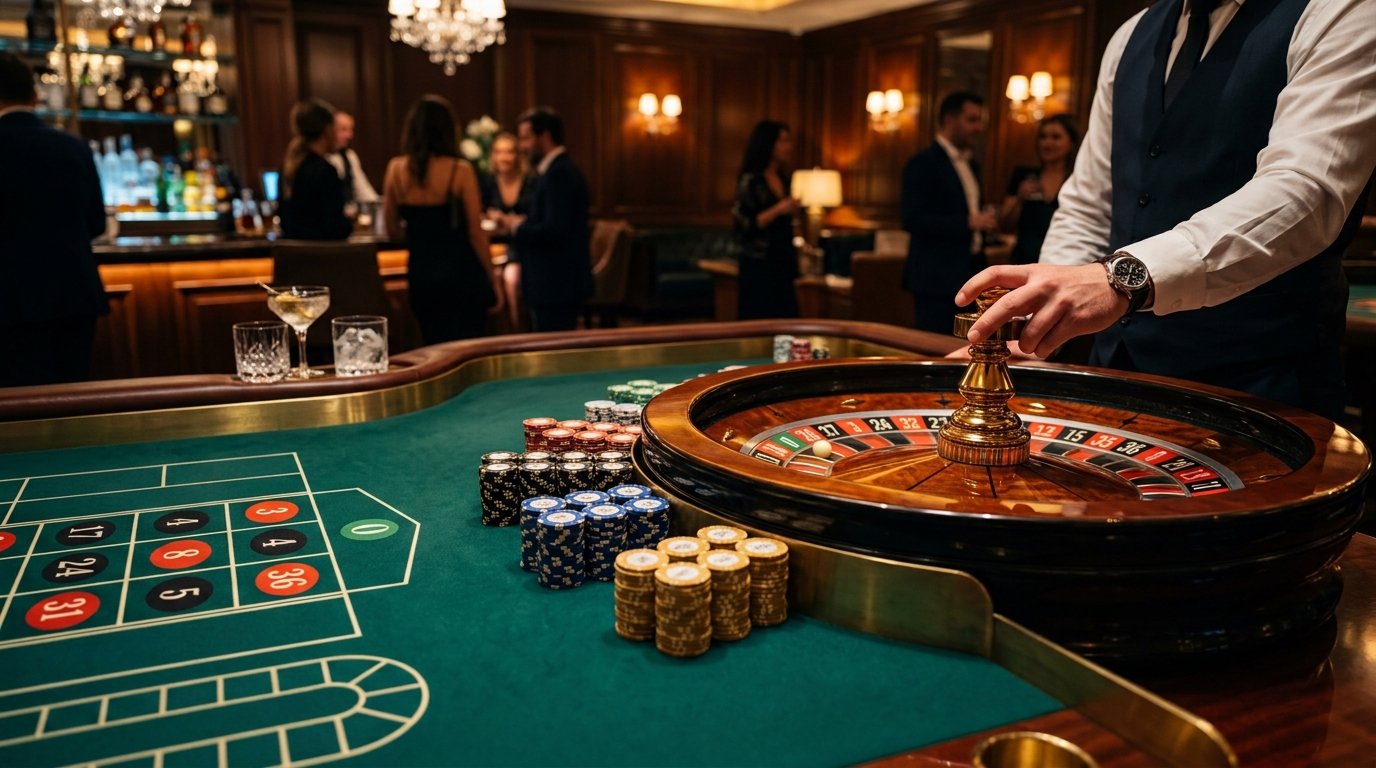
Quick Answer: A roulette bar table is a compact roulette setup — usually found at bars, social clubs, or home game rooms — built for casual play with a smaller wheel, simplified layout, and lower betting limits than a standard casino roulette table.
Most people assume a roulette wheel only belongs in a glittering casino hall, spinning under bright lights while a dealer in a vest calls out numbers. But there’s a smaller, quieter version of that same wheel showing up in bars, rec rooms, and social clubs everywhere — and it works a little differently than you’d expect. A roulette bar table is exactly what it sounds like: a scaled-down roulette setup designed for casual, social settings rather than a full casino floor. If you’ve ever stood next to one wondering how the numbers, chips, and betting spots actually connect, this guide will walk you through it from the ground up.
By the end of this article, you’ll understand what a roulette bar table actually is, how the wheel and betting layout work together, which rules apply, which mistakes trip up almost every beginner, and how it compares to the roulette tables you’d find in a full-scale casino.
What Is a Roulette Bar Table (and Why Beginners Struggle With It)
A roulette bar table is a smaller, self-contained version of the classic casino game. Instead of a large felt layout stretching across a pit with a dealer and multiple players, a bar table condenses the wheel and betting grid into a single compact unit — often small enough to sit on top of an actual bar counter or a dedicated stand.
Beginners tend to struggle for three simple reasons:
- The betting grid is shrunk down, so the numbers and sections look cramped compared to a full-size table.
- There’s rarely a dealer walking players through each step, so the pace feels faster and less guided.
- The wheel spins closer to players, which can make it harder to track where the ball actually lands the first few times.
None of this means the game is different underneath. The core logic — a spinning wheel, a small ball, and a grid of numbered betting spots — stays exactly the same. What changes is the presentation, not the rules.
Roulette Bar Table Rules Explained Step-by-Step

If you’ve never played before, here’s the basic sequence you’ll see at almost any roulette bar table:
- Place your chips. Before the wheel spins, players put chips on the number, color, or section of the betting grid they think the ball will land on.
- The dealer or host calls “no more bets.” Once the wheel starts spinning, betting stops immediately.
- The wheel spins in one direction, the ball spins in the other. This is what creates the unpredictable landing spot.
- The ball loses momentum and drops. It bounces across small dividers (called frets) before settling into one numbered pocket.
- The winning number is announced. A marker is placed on that number on the layout.
- Losing bets are cleared, winning bets are paid. Payouts depend on which type of bet was placed (a single number pays far more than a bet on red or black, for example).
- The marker is removed, and betting opens again for the next round.
Pro Tip: Watch a few full rounds before placing your first bet. You’ll pick up the rhythm of the “no more bets” call much faster than trying to read the rules mid-game.
How a Roulette Bar Table Actually Works (Mechanics)
Underneath the compact size, a roulette bar table runs on the same physics as any casino wheel. The wheel itself contains numbered pockets — typically 1 through 36, plus one or two zero pockets depending on the version being used. The wheel spins on a smooth, low-friction axis, while the ball is launched in the opposite direction along a track that lines the outer rim.
As the ball loses speed, it drops from that track onto the spinning wheel and bounces between small metal or plastic dividers before settling into a pocket. Because the wheel and ball move independently and the drop point isn’t controlled, the outcome of each spin is treated as random.
The betting layout mirrors this wheel exactly — it’s simply printed at a smaller scale. Each number on the felt corresponds to a specific pocket, and the color-coded sections (red and black, plus green for zero) match the physical wheel pocket for pocket.
Common Beginner Mistakes to Avoid
New players at a roulette bar table tend to repeat the same handful of errors:
- Betting after the wheel has already started spinning. Most bar tables enforce the same “no more bets” rule as a casino, even without a formal dealer.
- Confusing inside and outside bets. Inside bets (single numbers, small groups) pay more but hit less often. Outside bets (red/black, odd/even, high/low) pay less but land more frequently.
- Not checking the zero pockets. Some tables use a single zero, others use double zero — and that one difference changes the odds noticeably.
- Stacking chips incorrectly. On a smaller layout, chips placed slightly off the intended number can accidentally count as a different bet.
- Assuming previous spins predict the next one. Each spin is an independent event; the wheel has no memory of past results.
Pro Tip: Before your first round, ask (or look) whether the table uses a single zero or double zero layout — it’s the single biggest factor in how the odds are structured.
Terms and Terminology Explained
A few words come up constantly around a roulette bar table, and knowing them makes everything click faster:
- Frets: The small dividers between numbered pockets on the wheel that cause the ball to bounce before settling.
- Layout: The printed betting grid where chips are placed.
- Inside bet: A wager placed directly on a number or small cluster of numbers.
- Outside bet: A wager placed on broader categories like color, odd/even, or number ranges.
- En prison / la partage: Rules found on some single-zero tables that return part of an outside bet if the ball lands on zero.
- Neighbors bet: A wager covering a number plus the numbers physically next to it on the wheel (not the betting grid).
Tips for Understanding Roulette Bar Table Odds and Strategy
Because the wheel and layout are fixed, understanding the odds is really about understanding probability, not predicting outcomes. A single-number bet on a European-style wheel (one zero) covers 1 out of 37 pockets. On a double-zero wheel, that same bet covers 1 out of 38 pockets — a small but real difference in your chances.
Outside bets like red/black or odd/even sit close to a 50/50 split, minus whatever share the zero pocket(s) take up. This is exactly why some players prefer to study the table layout carefully before deciding where their attention (not necessarily money) is best spent — it’s a math exercise as much as a game.
Pro Tip: Try mentally tracking how many pockets each bet type actually covers rather than focusing on payout size alone. It gives you a clearer picture of how the odds are really distributed.
Myths vs Facts
| Myth | Fact |
|---|---|
| “The wheel is due for a certain color” | Each spin is independent; past results don’t influence future ones |
| “Bar tables are rigged differently than casino tables” | The wheel mechanics and pocket layout follow the same standards, just at a smaller physical size |
| “You can predict where the ball lands by watching the wheel speed” | Ball drop points are affected by too many variables to reliably predict by eye |
| “Betting patterns can beat the house edge” | The house edge comes from the zero pocket(s), not from how bets are sequenced |
Understanding the difference between what feels true and what the mechanics actually support is one of the fastest ways to genuinely understand this game rather than just memorizing terminology.
Comparison Table: Roulette Bar Table vs Standard Casino Roulette Table
| Feature | Roulette Bar Table | Standard Casino Table |
|---|---|---|
| Wheel size | Smaller, compact | Full-size |
| Setting | Bars, social clubs, home rooms | Casino floor |
| Dealer present | Sometimes, often self-managed | Always |
| Betting layout | Condensed grid | Full-size felt layout |
| Pace of play | Faster, less formal | Structured, dealer-paced |
| Zero pocket options | Varies by unit | Standard single or double zero |
Conclusion
A roulette bar table might look like a smaller, more casual cousin of the casino version — but the core mechanics never change. The wheel spins, the ball drops, and the odds are shaped entirely by how many pockets each bet type covers. Three things matter most as you get started: understand the step-by-step betting sequence, learn the difference between inside and outside bets, and always check whether the table runs a single or double zero layout before you try to make sense of the odds.
So next time you’re standing near one of these tables, what will you look for first — the zero pocket count, or how the dealer calls the betting window? If you enjoyed learning how the mechanics fit together, the natural next read is a deeper breakdown of how casino odds are calculated across different table games. Understanding the wheel is easy once you stop guessing and start counting the pockets.
FAQs
What is a roulette bar table?
A roulette bar table is a compact, smaller-scale version of a standard casino roulette setup, often used in bars, social clubs, or home game rooms. It uses the same numbered wheel and betting layout as a full casino table, just at a reduced physical size, and is generally used for casual, social-style play rather than formal casino gaming.
How many numbers are on a roulette bar table wheel?
Most roulette wheels, including bar table versions, use numbers 1 through 36 plus one or two zero pockets. The steps typically look like this:
- Numbers 1–36 are arranged around the wheel.
- A single zero pocket is added on European-style wheels.
- A second “double zero” pocket is added on American-style wheels.
Is a roulette bar table different from a real casino roulette table?
The core mechanics are identical — a spinning wheel, a ball, and a matching betting layout. The main differences are physical size, setting, and pace of play, since bar tables are often self-managed without a dedicated dealer walking through every step.
What’s the difference between inside and outside bets on a roulette bar table?
Inside bets cover single numbers or small clusters and pay more but land less often. Outside bets cover broader categories like color or odd/even, land more frequently, but pay less. Both bet types use the exact same wheel and layout on a roulette bar table
Does a roulette bar table use one zero or two?
It depends entirely on the specific table. Some use a single zero pocket (European-style), while others use both a single and double zero (American-style). This detail changes the odds slightly, since it affects how many pockets exist in total.
Can you predict where the ball will land on a roulette bar table?
No. Each spin is an independent event influenced by wheel speed, ball speed, and the small dividers (frets) the ball bounces across before settling. There’s no reliable way to predict the outcome by watching previous spins or wheel speed.