






Quick Answer: Monopoly jackpot rules govern how bonus rounds, wheel spins, and progressive prize triggers work in Monopoly-themed slot games. Jackpots typically activate through scatter symbols, bonus board landings, or random trigger events, with rules varying by game version and developer.
Ever landed on “Free Parking” in a Monopoly board game and wondered why the jackpot rules never quite made sense? That confusion carries straight over into Monopoly-themed slot machines, where monopoly jackpot rules confuse even experienced players. These games borrow the board game’s iconic imagery — the top hat, the railroads, the community chest — but the actual jackpot mechanics behind the reels work nothing like Monday night family game rules.
This guide breaks down exactly how these jackpot systems function, what triggers them, and why so many beginners misunderstand the odds involved. By the end, you’ll know the terminology, the common myths, and the actual mechanics driving these bonus features.
What Are Monopoly Jackpot Rules and Why Beginners Struggle With Them
The term “monopoly jackpot rules” refers to the mechanics that govern bonus rounds and prize triggers in Monopoly-branded slot games, most commonly found in land-based casinos and licensed online platforms. Unlike the physical board game, where “Free Parking” jackpots are often a house rule rather than an official one, slot machine jackpots follow programmed logic set entirely by the game developer.
Beginners struggle here for one simple reason: they assume board game logic applies. It doesn’t. There’s no dice-rolling around a board in the traditional sense — instead, there’s a randomized trigger system tied to symbol combinations, bonus wheels, or feature buys, depending on the specific title.
Another common source of confusion is that “Monopoly” isn’t one single game. Multiple developers have released different Monopoly-branded slots over the years, each with its own distinct jackpot structure. This means the rules for one version won’t necessarily apply to another, which is why understanding general mechanics matters more than memorizing specific numbers.
Pro Tip: Always check the paytable or information screen of the specific Monopoly game you’re looking at — jackpot mechanics differ significantly between versions.
Rules Explained Step-by-Step
While specifics vary by game, most Monopoly-themed jackpot features follow a similar general sequence:
- Base game play — Standard reel spins occur using normal symbols (properties, tokens, houses, hotels).
- Trigger symbols appear — Specific scatter or bonus symbols land in required positions (often 3 or more on the reels).
- Bonus round activation — Landing the required combination launches a separate bonus screen, often a virtual board.
- Board or wheel navigation — A dice-roll animation or wheel spin determines movement across a themed board.
- Prize zones — Certain spaces on the bonus board correspond to fixed prizes, multipliers, or progressive jackpot tiers.
- Jackpot qualification — Landing on a designated jackpot space (sometimes labeled “Free Parking” or similar) awards that tier’s prize.
- Round conclusion — The bonus ends after a set number of rolls, spins, or when a specific board space is reached.
Each of these steps is governed entirely by the game’s random number generator (RNG), meaning outcomes are not influenced by strategy or timing.
How the Jackpot Mechanics Actually Work Behind the Scenes
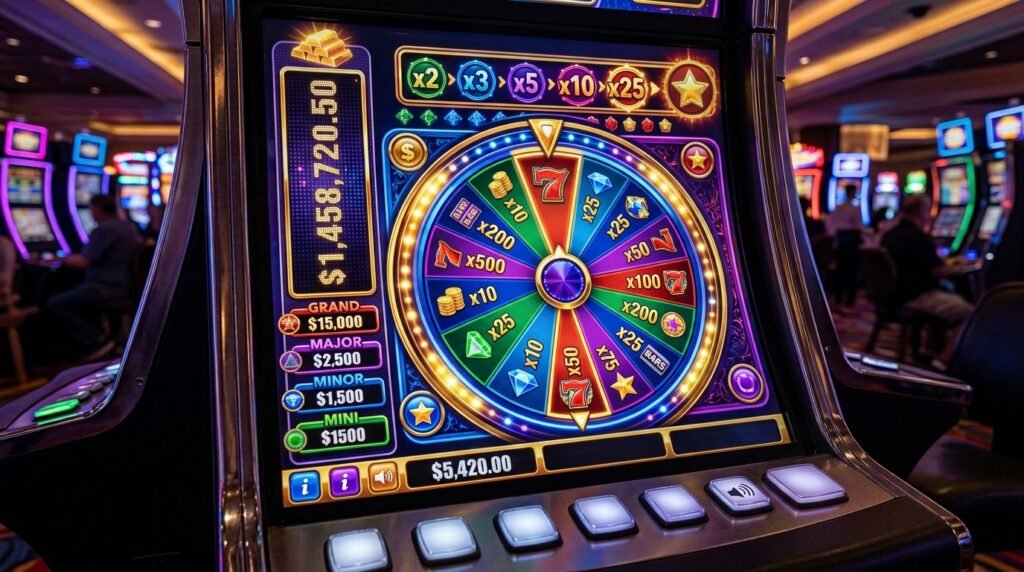
Understanding the mechanics requires letting go of the idea that there’s a visible “jackpot pool” ticking up like a giant meter you can watch fill. In most Monopoly slot games, jackpots fall into two categories:
Fixed jackpots are pre-set prize amounts tied to specific outcomes, like landing on a particular board space during the bonus round. These don’t grow over time.
Progressive jackpots increase gradually, funded by a small percentage of every wager placed across the game (sometimes across a network of machines). These require hitting a specific, often rare, combination to unlock.
The RNG behind these games ensures every spin or bonus trigger event is statistically independent. This means a jackpot doesn’t become “due” after a long dry streak — a common misunderstanding among players unfamiliar with how RNG-based systems function.
Volatility also plays a huge role here. High-volatility Monopoly slots tend to have larger, less frequent jackpot payouts, while low-volatility versions offer smaller, more consistent bonus triggers.
Common Beginner Mistakes to Avoid
Even attentive players fall into predictable traps when first exploring Monopoly jackpot rules:
- Assuming board game logic applies — Free Parking in the physical game is a house rule, not an official one, and it doesn’t translate to slot jackpot mechanics at all.
- Ignoring the paytable — Many players skip reading the information screen entirely, missing crucial details about trigger requirements.
- Confusing fixed and progressive jackpots — These operate under completely different funding and payout structures.
- Believing jackpots are “due” — RNG systems don’t work on a cycle; each spin is independent.
- Overlooking version differences — Assuming one Monopoly slot’s rules apply universally to all Monopoly-branded games.
Pro Tip: Reading the paytable before playing takes less than two minutes and clears up most confusion about how a specific jackpot triggers.
Key Terms and Terminology Explained
Understanding the vocabulary makes the rules far easier to digest:
- Scatter Symbol — A symbol that triggers bonus features regardless of its position on the reels.
- RNG (Random Number Generator) — The software system ensuring fair, unpredictable outcomes.
- Volatility — How often and how significantly a game pays out; high volatility means rarer but bigger wins.
- RTP (Return to Player) — A theoretical percentage representing how much of all wagered money a game returns over a very long period of play.
- Progressive Jackpot — A prize pool that grows as players wager, often across multiple linked machines.
- Bonus Board — A secondary, non-reel screen where players navigate a Monopoly-style board to reach prize zones.
Understanding the System: Tips for Better Comprehension
Since Monopoly jackpot outcomes are governed by RNG, there’s no strategic way to “beat” the system. However, understanding it better can make the experience far less confusing:
- Check the RTP percentage listed in the game’s information screen — this gives a long-term theoretical average, not a short-term guarantee.
- Differentiate between game versions — Look up which specific Monopoly title you’re viewing, since jackpot structures vary widely.
- Understand volatility ratings — This tells you what kind of payout pattern to expect (frequent-small vs. rare-large).
- Read bonus round rules carefully — Many bonus boards have specific rules about how many rolls or spins are allowed before the round ends.
None of these tips influence outcomes, since RNG systems are designed to be tamper-proof and statistically fair — they simply help you understand what you’re seeing on screen.
Myths vs. Facts About Monopoly Jackpot Rules
| Myth | Fact |
|---|---|
| Jackpots become “due” after a long time without hitting | Each spin/trigger is statistically independent; there’s no buildup toward a win |
| Free Parking always means a cash jackpot | This is a board game house rule, not an official slot mechanic |
| All Monopoly slots share the same jackpot rules | Every version has its own developer-specific mechanics |
| Higher bets always mean better jackpot odds | Trigger probability depends on the RNG, not bet size, though some progressive jackpots require max bets to qualify |
| You can predict when a bonus round will trigger | Bonus triggers are random and cannot be predicted or timed |
Comparison Table: Common Jackpot Trigger Types
| Trigger Type | How It Activates | Payout Style | Frequency |
|---|---|---|---|
| Scatter-Triggered Bonus | 3+ scatter symbols land on reels | Fixed or tiered prizes | Moderate |
| Bonus Board Navigation | Dice-roll or wheel spin inside bonus screen | Varies by board space | Low to moderate |
| Progressive Jackpot | Specific rare combination or max-bet qualification | Grows over time until won | Rare |
| Random Trigger Feature | Can activate on any spin, unrelated to symbols | Fixed jackpot tier | Very rare |
Wrapping Up
Monopoly jackpot rules aren’t governed by board game logic — they’re built on RNG systems, scatter triggers, and bonus board mechanics that differ from version to version. The three biggest takeaways: jackpots aren’t “due” after a dry spell, fixed and progressive jackpots work in fundamentally different ways, and reading the paytable before diving in clears up almost every point of confusion.
So next time you come across a Monopoly-themed jackpot feature, what will you check first — the paytable, the volatility rating, or the jackpot type? Understanding these fundamentals means you’re no longer guessing at how the game works.
Knowledge beats confusion, every single time.
FAQs
What triggers a Monopoly jackpot in slot games?
Monopoly jackpots are typically triggered by landing scatter symbols in required combinations, entering a bonus board round, or occasionally through a random trigger event unrelated to symbol positions. The exact requirement depends on the specific Monopoly-branded game, so checking the paytable is the most reliable way to confirm what activates the feature in any given version.
Is the Free Parking jackpot real in Monopoly slots?
In the original board game, Free Parking jackpots are a house rule, not part of official rules. In Monopoly-themed slots, some versions do include a “Free Parking” bonus space on the digital board, but it functions as a programmed prize zone rather than a pooled cash jackpot like players might expect.
Do all Monopoly slot games have the same jackpot rules?
No. Different developers have created separate Monopoly-branded slots over the years, each with distinct jackpot structures. Rules can include:
- Different scatter symbol requirements
- Unique bonus board layouts
- Separate progressive jackpot pools
Always check the specific game’s information screen for accurate rules.
What’s the difference between fixed and progressive Monopoly jackpots?
Fixed jackpots pay a pre-set amount when a specific bonus outcome occurs, while progressive jackpots grow over time based on a percentage of total wagers across the game or network. Progressive jackpots usually require a rarer trigger condition or specific qualifying bet to become eligible.
Can you predict when a Monopoly jackpot will trigger?
No. Jackpot triggers rely on random number generator (RNG) technology, meaning every spin or bonus event is statistically independent from the last. There’s no pattern, cycle, or “hot streak” that reliably predicts an upcoming trigger, regardless of how long it’s been since the last one occurred.
What does RTP mean in relation to Monopoly jackpot rules?
RTP, or Return to Player, is a theoretical percentage showing how much wagered money a game returns over a very large number of spins. It doesn’t predict short-term outcomes or guarantee individual results, but it helps players understand the long-term mathematical design behind a specific Monopoly slot version.