






Picture this: it’s a Tuesday night, you’ve got a glass of something in one hand and your phone in the other, and you’re watching a dealer named Nikola shuffle actual cards in what looks like a TV studio somewhere in Eastern Europe. She calls out your username when you place a bet. The wheel spins. It’s real. But it’s also somehow beamed straight into your bedroom. If you’ve ever paused mid-hand and thought “wait, how does this actually work,” you’re not alone — it’s probably the single most-asked question I get from readers who’ve just discovered live dealer games exist.
I’ve spent the better part of six years testing these tables across Evolution, Pragmatic Play Live, and a few smaller studios most people have never heard of, and I still find the mechanics genuinely interesting. This article breaks down exactly how does live dealer casino work — the cameras, the software, the people, and the parts that are more automated than you’d probably guess. No fluff, no “in today’s digital age” nonsense. Just what’s actually happening between that dealer’s hands and your phone screen.
What Live Dealer Casino Actually Means
Let’s clear something up first, because a lot of players confuse this with regular online casino games. A standard online blackjack or roulette game uses a random number generator (RNG) — software decides the outcome, full stop. There’s no wheel, no cards, nothing physical. Live dealer games flip that entirely. A real person deals real cards or spins a real wheel in a physical location, and that footage streams to you in close to real time, usually with a lag of under a second if your connection’s decent.
Evolution Gaming, the biggest player in this space by a mile, runs studios in Riga, Latvia and Burton-upon-Trent in the UK, plus a newer one in Pennsylvania for the regulated US market. Pragmatic Play Live operates out of Bucharest and Malta. These aren’t small closets with a webcam — Evolution’s Riga studio alone reportedly spans more than 200,000 square feet and runs dozens of tables simultaneously, 24 hours a day.
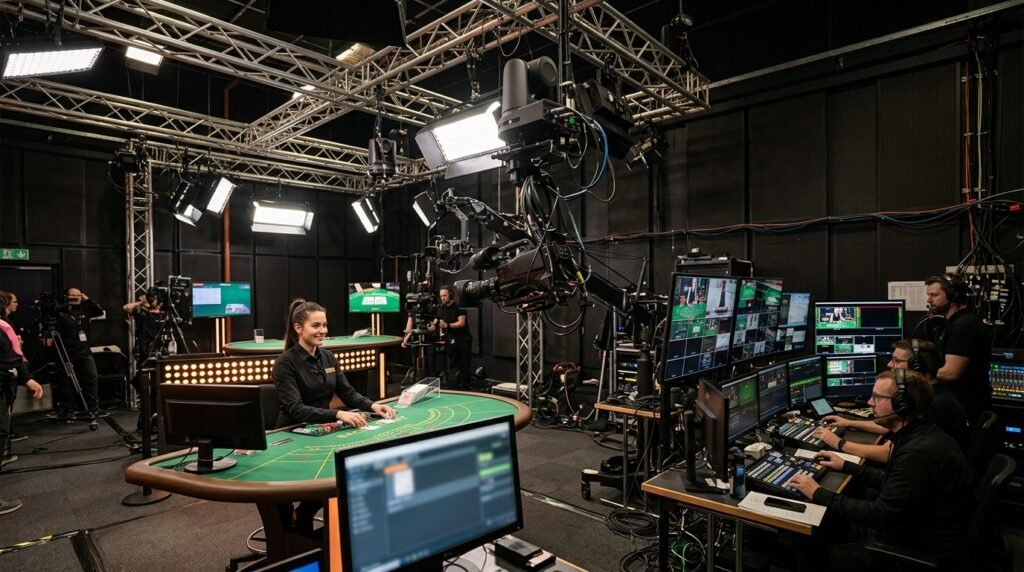
The Studio Setup: More TV Production Than Casino Floor
Honestly, the first time I toured photos and behind-the-scenes footage of one of these studios, it looked less like a casino and more like a small-scale ESPN broadcast set. Every table sits under specific lighting rigs designed to eliminate shadows that could obscure a card or a chip. Multiple cameras — often between four and eight per table — capture different angles: one overhead shot of the cards, one wide shot of the dealer, sometimes a dedicated shot just for the wheel or the shoe.
The dealers themselves go through actual training programs. Evolution’s dealers, for instance, train for weeks before going live, covering everything from proper card handling to how to speak clearly for the camera, to game-specific rules for titles like Lightning Roulette or Crazy Time. They also work in shifts — usually 8 hours — under conditions that would honestly make anyone’s back hurt just thinking about it.
Here’s the part most players don’t think about: temperature. Studios keep these rooms noticeably cool, often around 66-68°F, because the equipment generates a ton of heat and because dealers standing for hours need the room cold to stay sharp. If you’ve ever noticed dealers wearing what look like slightly heavier uniforms, that’s why.
The Tech That Makes It Actually Work
This is where the “how does live dealer casino work” question gets interesting, because there’s more automation happening than most players assume.
- Optical Character Recognition (OCR): Cameras don’t just show you the cards — software actually reads the card values and suits in real time using OCR, converting what the dealer deals into data your screen displays instantly. That’s how you see card values pop up on your interface within a fraction of a second of the dealer flipping them.
- RFID chips in roulette balls and wheels: A lot of live roulette wheels use sensors embedded in the wheel itself to detect exactly where the ball lands, which is how the result registers on your screen almost instantly rather than someone manually entering it.
- Game Control Unit (GCU): Every table has a small device, roughly the size of a shoebox, that encodes the video feed and processes all the data before sending it to the streaming server. Without this box, none of it works — it’s genuinely the unsung hero of the whole operation.
- Monitors facing the dealer: Dealers can see player bets, chat messages, and game data on a screen positioned just out of camera view, which is how they can call out “Player at table, your bet is in” without looking confused.
When I tested Pragmatic Play’s Mega Roulette a few months back, the ball drop-to-result registration was close to instant — maybe half a second delay, which for a physical wheel is honestly impressive.
Is It Actually Fair? The Randomness Question
This is the part players genuinely worry about, and it’s a fair concern in a YMYL niche like gambling. Since a human is physically dealing cards or spinning a wheel, could a dealer manipulate outcomes?
Practically speaking, no — and here’s why. The physical randomness (the ball’s bounce, the shuffle) combines with strict procedural controls: dealers rotate shifts, cards get reshuffled per strict schedules or use continuous shuffling machines, and every studio operates under independent auditing from firms like eCOGRA or GLI (Gaming Laboratories International), which test both the RNG-supported elements (like that lightning-round multiplier in Lightning Roulette) and the physical fairness of wheels and shoes.
State-regulated markets add another layer. In New Jersey, Pennsylvania, and Michigan — the three biggest regulated live dealer markets in the US — operators need licenses through the state gaming commissions, and those commissions audit both the software and the physical equipment periodically. Players often report feeling more confident at regulated US-facing tables specifically because of this oversight, and honestly, that instinct is correct.
Latency, Lag, and Why Your Connection Matters More Than You Think
Something nobody mentions enough: your experience of “how live dealer casino works” depends heavily on your own internet connection, not just the studio’s tech. A shaky connection can cause the video feed to buffer while the actual game keeps moving, which sometimes means you miss the window to place a bet. Most platforms give you a countdown timer — usually 10-13 seconds for roulette, slightly shorter for blackjack — and if your stream lags, that window can close before your bet registers.
I’d genuinely recommend a wired connection over WiFi if you’re playing anything with tight betting windows, like Speed Baccarat, which sometimes runs full rounds in under 30 seconds.
Popular Live Dealer Games You’ll Actually Run Into
- Lightning Roulette (Evolution) — standard roulette with random multiplier numbers added each round
- Crazy Time — a game show-style wheel spin with bonus rounds
- Blackjack Party — a livelier, more social version of standard live blackjack
- Mega Baccarat — high-limit baccarat tables with side bets
- Infinite Blackjack — unlimited seats at one table, no waiting for a spot
Each of these blends the same core technology described above, just wrapped in different game rules and bonus mechanics.
FAQs
Is live dealer casino rigged?
No credible evidence supports that regulated live dealer games are rigged. Licensed studios undergo independent audits from bodies like GLI, and state gaming commissions in NJ, PA, and MI actively monitor operators.
Why does the video sometimes freeze or lag?
Usually it’s your connection, not the studio’s. Live video streaming depends on stable bandwidth, and interruptions on your end can cause missed betting windows even though the actual game continues.
Can dealers see how much I’m betting?
Dealers see aggregated bet data on their monitor, not individual player identities in most cases, though usernames sometimes appear for chat interaction purposes.
Do live dealer games have better odds than RNG games?
Not inherently — the house edge on live blackjack or roulette mirrors standard versions of the same game. The difference is experience, not payout odds.
Are live dealer casinos legal in the US?
Yes, in states with regulated online gambling, including New Jersey, Pennsylvania, Michigan, West Virginia, and Connecticut. Availability depends entirely on your state’s laws.
Final Word
Live dealer casino games are genuinely one of the more fascinating hybrids in modern gambling — real people, real equipment, wrapped in software that’s honestly more sophisticated than most players realize. Nothing here guarantees you’ll win, and no game format changes the math of the house edge. If you’re going to try a live table, stick to licensed, regulated platforms in your state, set a budget before you sit down, and treat it as entertainment first.
18+. Gamble responsibly. If gambling stops being fun, resources like the National Council on Problem Gambling (1-800-522-4700) are available.
Ready to see it for yourself? Try a live dealer table at a licensed operator in your state tonight — just start small and watch how the tech actually plays out in real time.