





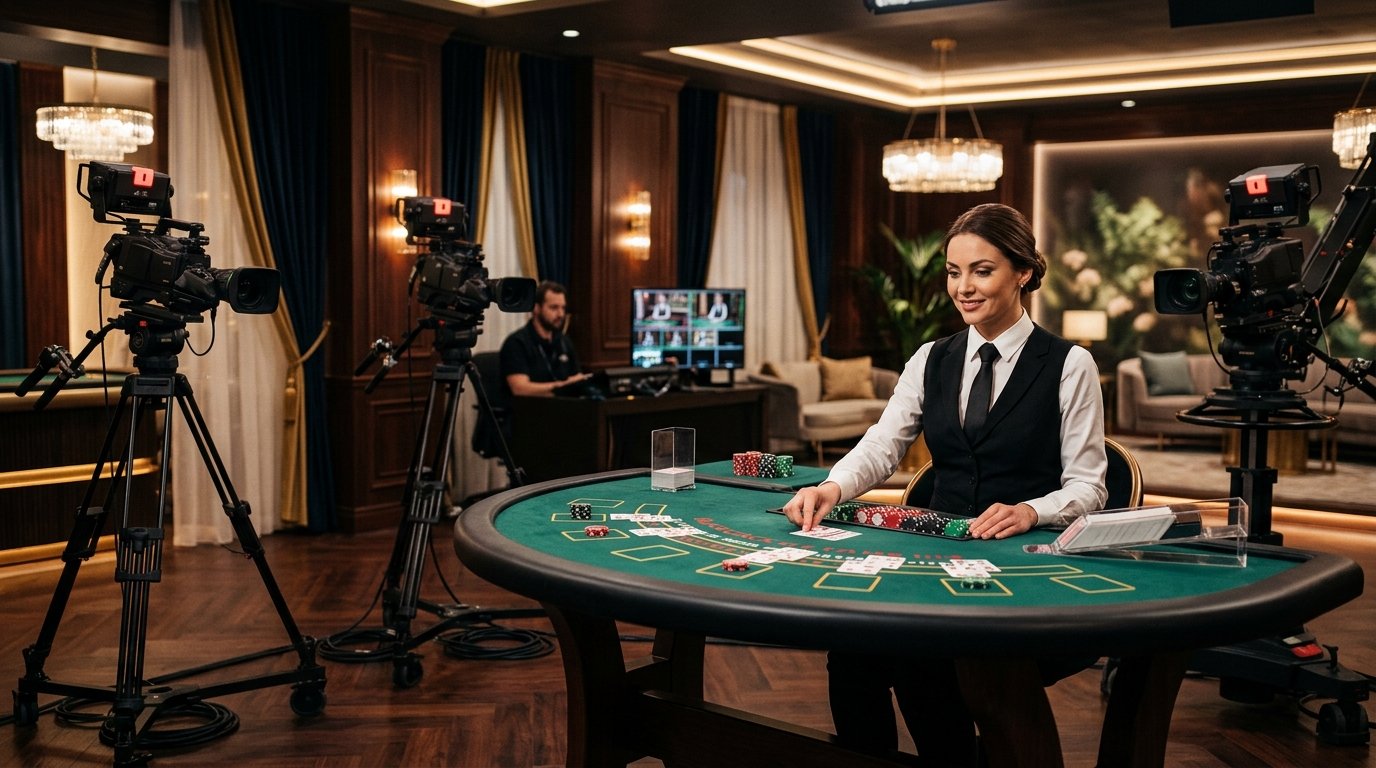
You’re sitting on your couch in sweatpants, watching a real woman in a sequined dress deal blackjack from what looks like a Vegas floor. Except she’s not in Vegas. She’s probably in a studio outside Riga, Latvia, or maybe Bucharest, and there are seventeen other camera angles pointed at that same table that you’ll never see. So how does live dealer casino work, exactly? Is it rigged? Is there actually a person shuffling those cards, or is it some elaborate CGI trick designed to make you trust an algorithm more?
I’ve spent a good chunk of the last several years digging into how these platforms operate — testing tables on Evolution-powered sites, DraftKings, and BetMGM, talking to people who’ve worked studio floors, and yes, occasionally losing more than I’d like to admit at Lightning Roulette. So let’s actually pull back the curtain. This isn’t a marketing pitch. It’s the mechanics, the tech, the money, and the stuff nobody tells you until you’ve already deposited $200.
The Short Version: It’s a TV Studio, Not a Casino Floor
Here’s the thing people get wrong immediately. Live dealer games aren’t filmed on an actual casino floor. They’re shot in purpose-built television studios — usually windowless, climate-controlled rooms designed from scratch for broadcasting. Evolution Gaming, the company that powers roughly 70% of the live dealer market according to industry estimates, operates studios in Riga, Bucharest, Georgia, Malta, and a handful of other spots most players never think about.
Each table sits inside its own mini-set. Bright, even lighting (so cameras never struggle), a green-screen-style backdrop in some cases, and enough camera hardware to make a Netflix crew jealous. A single blackjack table typically runs 3 to 5 cameras — one overhead shot for the cards, one on the dealer’s face, one on the chip tray, sometimes a roaming camera for atmosphere. Roulette tables often use a dedicated camera just for tracking the ball, synced with optical character recognition software that reads the winning number in real time and feeds it straight into the game software.
That’s the part that surprises people most: there’s a computer watching the wheel just as closely as you are.
Who’s Actually Running the Table
The dealers are real employees, not contractors pulled off Craigslist. Evolution alone employs thousands of dealers across its studio network, and most go through weeks of training before they’re allowed near a live table — card handling speed, house rules for a dozen different game variants, and how to keep composure when a player at 3am starts typing insults in the chat box because they lost four hands in a row.
Dealers usually work in rotating shifts since these studios run 24/7 — someone in Ohio playing at 2pm is watching a dealer who might be working a night shift Riga time. There’s a pit boss equivalent walking the floor too, and most studios keep a supervisor watching multiple tables on monitors, partly for quality control and partly for security.
One thing I noticed when I first started testing these platforms: the dealers genuinely do react to the game. They’ll comment when someone hits a big multiplier on Crazy Time, they’ll acknowledge a losing streak, they’ll wish someone luck by name if the chat shows it. That’s not scripted — it’s just people doing repetitive shift work who’ve gotten decent at making it feel personal.
The Tech Stack Nobody Talks About
This is where “how does live dealer casino work” actually gets interesting, because the software side is doing more heavy lifting than the human side.
Game Control Unit (GCU): Every live table has a small box attached to it — about the size of a shoebox — that encodes the video feed and communicates with the software. This GCU is what turns the dealer’s physical actions (dealing a card, spinning a wheel) into digital data the platform can read and translate into your bets, payouts, and screen animations. Without it, you’re just watching a livestream with no way to actually play.
Optical Character Recognition (OCR): For roulette and card games, cameras use OCR to instantly identify card values or the number the ball lands on. This happens in milliseconds and is cross-checked against the dealer’s manual actions as a fraud-prevention layer.
RFID chips (in some formats): Certain premium tables, especially in poker variants, use RFID-embedded cards or chips so the system can track exact positions and values without relying purely on cameras.
Latency and streaming infrastructure: Studios stream via low-latency protocols so the video feed you see is only about 1-2 seconds behind real time — close enough that it doesn’t feel delayed, but with enough buffer to prevent cheating via stream manipulation.
Honestly, this is the part I respect most about the whole setup. It would be so much cheaper for operators to just run RNG (random number generator) games with a video overlay pretending to be live. A few shady operators have actually tried that over the years and gotten caught, which tanked their licensing. The legitimate providers — Evolution, Pragmatic Play Live, Ezugi — invest heavily in this hardware specifically because the entire value proposition of live dealer is “this is real, not simulated.” Cut that corner and the whole product collapses.
How the Money Actually Moves
When you place a bet on a live blackjack hand through, say, BetMGM or Caesars Palace Online, here’s the actual flow:
- You click your chip amount on the digital overlay
- That bet data gets sent to the GCU at the physical table
- The dealer deals the physical cards
- Cameras + OCR confirm the card values
- The software cross-references your bet against the outcome
- Payouts are calculated and credited to your account balance, usually within seconds
The house edge works exactly the same way it would on a physical Vegas floor. Live blackjack typically carries a house edge around 0.5% to 1% depending on the ruleset (number of decks, whether the dealer hits or stands on soft 17). Live roulette — assuming it’s American double-zero — sits at 5.26%, while European single-zero drops to 2.7%. None of that changes just because there’s a camera involved instead of you standing at a physical table. The math doesn’t care where you’re sitting.
Live Dealer vs. RNG Games: The Real Difference

I get asked this constantly, so let’s settle it plainly. RNG (Random Number Generator) games — your standard digital slots, digital blackjack, digital roulette — generate outcomes through a certified algorithm with no physical component at all. Live dealer games generate outcomes through an actual physical event (a card, a spinning wheel, a dice roll) that’s then digitized and verified.
Why does that matter to you as a player? A few reasons:
- Trust perception. Some players simply don’t fully trust RNG outcomes, even when they’re independently audited. Watching a real wheel spin removes that doubt entirely.
- Pacing. Live games move slower than RNG games by design — a live blackjack round takes maybe 45-60 seconds versus 15-20 seconds for a digital hand. That’s actually a positive for bankroll management, even if it doesn’t feel like it in the moment.
- Social element. Chat functions, other players at the table, dealer interaction — RNG games can’t replicate that.
- No autoplay tricks. You can’t spam-click through live games the way you can burn through 200 digital slot spins in three minutes.
I’ll be honest here: for pure entertainment value, live dealer wins every time for me. But if you’re grinding for volume — chasing a specific wagering requirement on a bonus, for instance — RNG games are almost always the more efficient route because of speed alone.
Licensing and Fairness — What Actually Keeps This Honest
Live dealer studios operating for U.S.-facing licensed sites (New Jersey, Michigan, Pennsylvania, Connecticut, West Virginia) fall under state gaming commission oversight, plus whatever jurisdiction the studio itself is licensed in — Malta Gaming Authority is the most common for Evolution’s European studios. These regulators require regular audits of shuffle machines, camera integrity, and payout accuracy.
Physical shuffling, by the way, is rarely done by hand anymore on high-volume tables. Most studios use automatic card shuffling machines between hands specifically to eliminate any dealer-introduced bias or predictability — and to speed up the game, since manual shuffling would slow throughput to a crawl.
Player-facing complaints do happen — stream freezes, disconnects mid-hand, disputes over whether a bet registered in time. Reputable operators have documented resolution processes for exactly this, usually reviewing the studio-side footage to confirm what actually happened. If a platform can’t or won’t do that when you ask, that’s a red flag worth taking seriously.
What Surprised Me Most When I Actually Watched a Studio Tour
Evolution has published behind-the-scenes tours of a few of their studios, and I’ll admit — even having researched this space for years, seeing the sheer scale of it was different. Some studios run 40+ tables simultaneously, all broadcasting to different regional platforms at once, with a production control room monitoring feeds the way a live sports broadcast would. It’s less “casino” and more “24-hour television network that happens to deal cards.”
FAQs
Is live dealer casino actually real, or is it recorded?
It’s real and live, not pre-recorded. Every hand, spin, or roll happens in real time in a broadcast studio, streamed to your device with only a second or two of delay.
Can a live dealer cheat or manipulate outcomes?
It’s extremely difficult given the layers involved — camera verification, OCR cross-checks, supervisor monitoring, and regulatory audits all work together specifically to prevent that. No system is theoretically flawless, but manipulation would require compromising multiple independent verification layers at once.
Why do live dealer games have higher minimum bets than RNG games?
Because there’s real operational cost behind them — studio space, staff salaries, hardware, streaming infrastructure. RNG games run on servers with near-zero marginal cost per hand, so operators can afford $0.10 minimums. Live tables often start around $1 to $5.
Do live dealer games count toward casino bonus wagering requirements?
Sometimes, but often at a reduced contribution rate — many operators count live dealer wagers at 10-20% toward requirements versus 100% for slots. Always check the specific bonus terms before assuming your live blackjack session is clearing your bonus.
What happens if my internet disconnects mid-hand on a live table?
Reputable platforms save your bet and the hand outcome server-side, so reconnecting typically shows you the result and settles your balance accordingly. It’s still worth confirming your specific operator’s disconnect policy before playing on shaky wifi.
Live dealer casino gaming is genuinely one of the more transparent formats in online gambling once you understand what’s actually happening behind the stream — real people, real cards, and a surprising amount of broadcast-grade technology working to keep it honest. That said, the house edge is still the house edge, no matter how good the production value looks.
18+. Gamble responsibly. If gambling stops being fun, it’s time to step away — resources like 1-800-GAMBLER are available if you need support.
Ready to see it for yourself? Pick a licensed live dealer platform in your state, start at a low-stakes table, and watch a few hands before you bet a dime — it’s the fastest way to understand the flow firsthand.