






Quick Answer A payline is a specific pattern across a slot machine’s reels where matching symbols must land to trigger a payout. Traditional slots use straight or zigzag lines, while modern games often use “ways to win” or cluster systems instead of fixed lines.
Introduction
Ever stared at a slot machine screen and wondered why three matching symbols didn’t pay out? You’re not alone. Slot machine paylines explained the right way can save beginners a lot of confusion, because paylines are the invisible rulebook behind every spin. They decide which symbol combinations count and which ones don’t, and most new players never learn to read them properly. In this guide, you’ll learn what paylines are, how they’re structured, the difference between fixed and adjustable lines, and how modern slots have changed the concept entirely.
What Are Slot Machine Paylines, and Why Do Beginners Struggle With Them?
A payline is simply a pre-set pattern that runs across the reels of a slot machine. When the right symbols land along that exact pattern, you get paid. It sounds simple, but the confusion usually starts because paylines aren’t always straight.
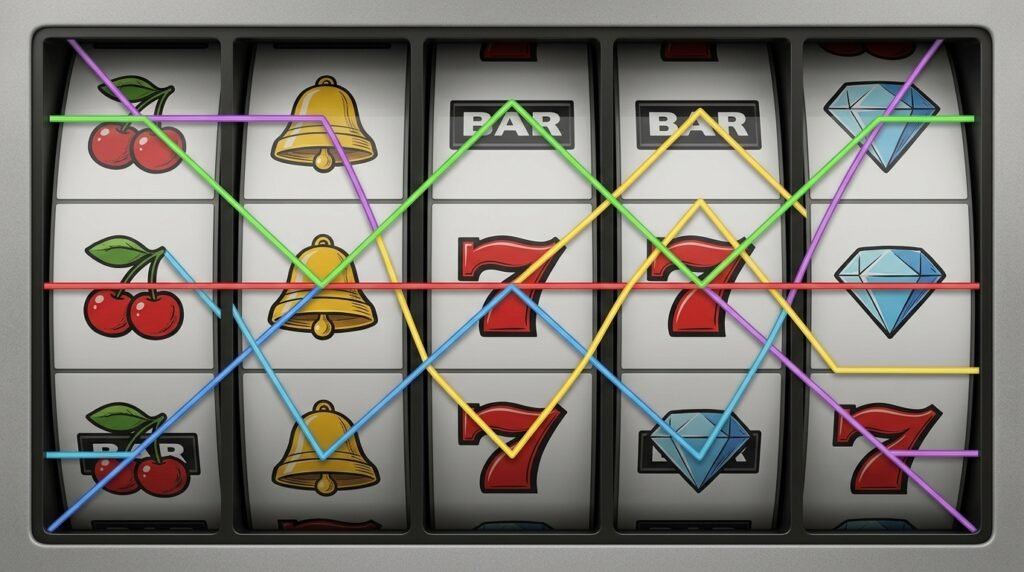
Older machines used a single horizontal line across the middle of the reels. Today’s slots often run lines in zigzags, V-shapes, or diagonals, and a five-reel game can have anywhere from 10 to over 100 of them active at once. Beginners struggle because they assume any three matching symbols anywhere on the screen will pay — but if those symbols don’t fall on an active payline, nothing happens.
Understanding slot machine paylines is really about understanding geometry on a grid. Each line is a fixed route through the reels, and your symbols need to follow that exact route from left to right (in most games) to count.
Slot Paylines Rules Explained Step-by-Step
Here’s how payline rules typically work, broken down into a simple sequence:
- Check the paytable first. Every slot has a paytable showing how many paylines it uses and what each symbol pays.
- Identify the starting reel. In most slots, winning combinations must start from the leftmost reel and move right.
- Match symbols along the pattern. The game checks each active payline individually to see if consecutive symbols match.
- Count consecutive matches. Payouts usually require three, four, or five matching symbols in a row along that line.
- Multiple lines can win simultaneously. If several paylines hit at once, their payouts are added together.
- Wild symbols may substitute. Wilds often fill in for missing symbols to complete a line, unless the paytable says otherwise.
How Paylines Actually Work Mechanically
Behind the graphics, every slot spin is powered by a random number generator (RNG) that determines which symbols land on which reel positions. The paylines themselves don’t affect the randomness — they’re simply the lens through which the game checks for wins after the reels stop.
Picture the reels as a grid, usually three rows by five columns on modern video slots. A payline is a mapped-out route through specific cells in that grid — for example, straight across row two, or zigzagging between rows one, two, and three. The game software checks every active line against the final symbol layout and calculates payouts based on matches.
Pro Tip: More paylines don’t automatically mean better odds — they mean more chances to match a small combination, which often balances out with lower payouts per line.
This is why two slots with the same symbols can feel completely different to play. A 9-payline classic slot and a 100-payline video slot distribute risk and reward in very different ways, even if the core mechanics are similar.
Common Beginner Mistakes When Reading Paylines
New players tend to run into the same handful of misunderstandings.
- Assuming all paylines are always active. Some older games let you choose how many lines to activate, meaning you could miss a winning pattern simply because it wasn’t turned on.
- Expecting matches to count in any direction. Most paylines only pay left to right, so a match starting on the far-right reel usually won’t count.
- Confusing scatter symbols with payline symbols. Scatters typically pay regardless of position, which trips up players who think every symbol needs to sit on a line.
- Ignoring the paytable’s specific line map. Every game has a different set of line shapes, and assuming they’re identical to the last game you played is a common error.
Key Terms and Terminology You Should Know
Slot terminology can feel like its own language. Here are the essentials:
- Payline: The specific pattern across reels where matching symbols trigger a win.
- Ways to win: A system where matches count regardless of exact position, as long as symbols appear on consecutive reels.
- RTP (Return to Player): A theoretical percentage showing how much a game returns to players over a long period of play.
- Scatter symbol: A symbol that pays or triggers bonus features regardless of where it lands.
- Wild symbol: A symbol that substitutes for other symbols to help complete a payline.
- Volatility: How often and how large a slot’s payouts tend to be.
Strategy Tips for Understanding Paylines Better
You don’t need to “beat” a slot’s math to get more out of your understanding of how it works. A few habits make the mechanics much clearer.
Start by reading the paytable before you ever watch a single spin — it tells you exactly which patterns matter. Next, compare a few different games side by side; noticing how a 20-line slot differs from a 243-ways slot builds intuition faster than reading theory alone.
Pro Tip: Try sketching out a payline pattern on paper from the paytable diagram. Physically tracing the shape helps most beginners “see” how the win condition works far better than staring at the screen.
Finally, pay attention to how bonus features interact with paylines. Some free-spin rounds add extra lines or switch the game to an all-ways format temporarily, which changes how you should read the screen.
Myths vs. Facts About Slot Paylines
| Myth | Fact |
|---|---|
| More paylines always mean better odds | More lines mean more combinations checked, not necessarily better long-term odds |
| A symbol touching a line counts as a win | Symbols must land exactly on the payline’s mapped positions |
| All slots use traditional paylines | Many modern slots use “ways to win” or cluster-pay systems instead |
| Paylines affect the RNG outcome | Paylines only interpret results; they don’t influence which symbols appear |
| You must always bet on all paylines | Some games allow adjustable lines, though many modern slots require full-line betting |
Comparison Table: Payline Systems at a Glance
| System | How It Works | Typical Line Count | Direction |
|---|---|---|---|
| Fixed Paylines | Set number of active lines, unchangeable | 9–50 | Left to right |
| Adjustable Paylines | Players choose how many lines to activate | 1–25 | Left to right |
| Ways to Win | Matches count based on adjacent reels, not fixed lines | 243–1024+ | Left to right |
| Cluster Pay | Symbols must form connected clusters, no lines at all | N/A | Any direction |
Conclusion
Paylines are the framework that turns a random spin into a readable outcome. To recap: a payline is a fixed pattern that symbols must follow to count as a win, the paytable is your best resource for understanding a specific game’s structure, and modern slots increasingly use “ways to win” or cluster systems instead of traditional lines. Once you understand how a game’s paylines are mapped, the whole screen starts to make a lot more sense.
So next time you load up a slot, will you check the paytable before your first spin? If you want to go deeper, a guide on RTP and volatility is a natural next read to round out your understanding of how slots are built. Understanding the pattern is the first step to understanding the game itself.
FAQs
What is a payline on a slot machine?
A payline is a set pattern across the reels where matching symbols must land to create a winning combination. It can be a straight line, a zigzag, or another shape defined by the game’s paytable. Not every symbol on the screen counts — only ones sitting exactly on an active payline route.
How do slot machine paylines explained differently in “ways to win” games work?
Ways to win” games don’t use fixed line shapes. Instead, matches count as long as symbols appear on consecutive reels, regardless of their row position. This system often creates hundreds of ways to win: 1) matches can start from either side depending on the game, 2) symbols don’t need to align on a specific row, and 3) more combinations are checked per spin.
Do more paylines mean better odds of winning?
Not necessarily. More paylines increase the number of combinations being checked each spin, but individual line payouts are often smaller to balance the math. The overall return is shaped by the game’s RTP and volatility, not simply the number of lines.
Can paylines pay in both directions?
Most traditional paylines only pay when matches start from the leftmost reel and move right. Some newer games allow both-ways payouts, meaning matches can count from either side. It depends entirely on the individual game’s rules, so checking the paytable is essential.
Why didn’t my matching symbols pay out?
This usually happens when the matching symbols didn’t land on an active payline’s exact pattern. It can also happen if a payline wasn’t activated on games with adjustable lines. Reviewing the paytable’s line diagrams clears up most of this confusion quickly.
What’s the difference between paylines and scatter symbols?
Paylines require symbols to land in a specific pattern to count as a win. Scatter symbols work differently — they typically pay or trigger bonus rounds based on how many appear anywhere on the screen, regardless of position. This is why scatters can feel like an exception to normal payline rules.