






Quick Answer: Blackjack and video poker typically offer the best player odds among casino games, with house edges as low as 0.5% under optimal play. Baccarat and certain craps bets also rank highly. Slots and most side bets carry the worst odds, often exceeding a 5-10% house edge.
Most casino visitors have no idea that the difference between the best and worst odds in a casino can be as wide as 15 percentage points. That single fact changes everything about how you should think about the games on the floor. If you’ve ever asked yourself what casino game has the best odds, the honest answer isn’t one game — it’s a handful of games, and the specific rules and bets you choose within them matter just as much as the game itself.
This guide walks you through how odds actually work, which games consistently rank best for players, the mistakes beginners make when judging odds, and how to read the numbers so you’re never guessing again.
What “Best Odds” Actually Means in a Casino
When people ask what casino game has the best odds, they’re usually really asking: which game gives the house the smallest mathematical advantage? That advantage is called the house edge, and it’s the single most important number in any casino game.
Beginners struggle with this concept for a simple reason: odds and house edge sound like the same thing, but they aren’t. Odds describe the probability of a specific outcome happening. House edge describes the percentage of every wagered dollar the casino expects to keep over the long run, across all outcomes combined.
A game can have odds that feel favorable on a single hand or spin while still carrying a high house edge overall, because rare high-paying outcomes are balanced against many small losses. Understanding this distinction is the first step to reading any casino game correctly.
How Odds Are Calculated: Step-by-Step
Casino odds aren’t mysterious once you break them into their components. Here’s how the math is built.
- Identify all possible outcomes. Every game has a finite set of results — a card total, a dice roll, a reel combination.
- Assign a probability to each outcome. This is based on the physical or mathematical structure of the game (52 cards, 38 roulette pockets, a specific slot reel configuration).
- Apply the payout for each outcome. Casinos always pay out at odds slightly worse than the true probability of winning.
- Calculate the expected value. Multiply each outcome’s probability by its payout, then sum the results.
- Convert expected value into house edge. The gap between a fair payout and the actual payout, expressed as a percentage, is the house edge.
- Factor in player decisions. In skill-based games, your choices shift the realized odds closer to (or further from) the theoretical best case.
This process is why two people can play the same game and experience very different long-term results — one is playing optimally, and one isn’t.
How the Best-Odds Games Actually Work
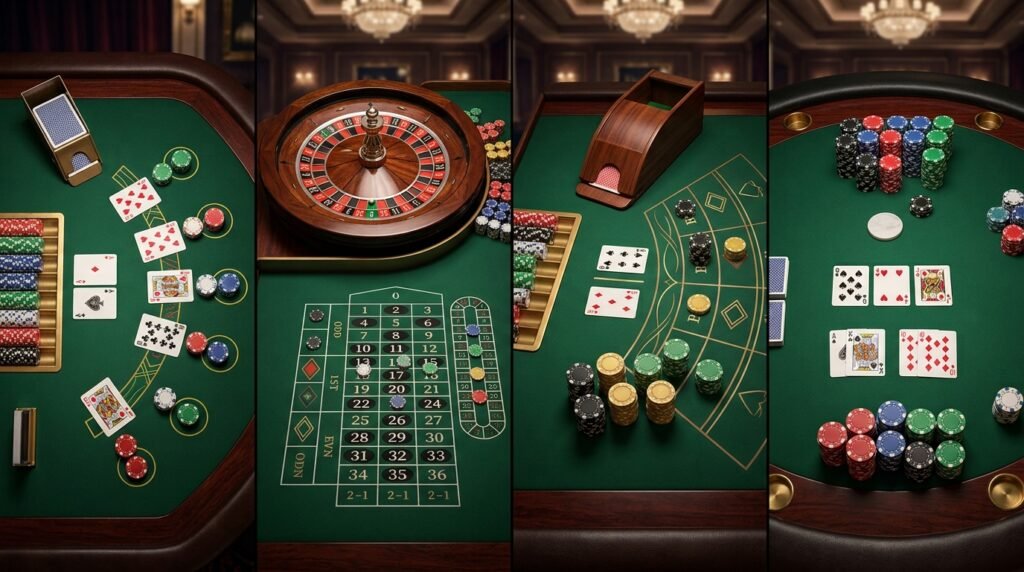
The games with the lowest house edges share a common trait: they involve either fixed, well-understood probabilities or an element of player skill that narrows the gap between the house and the player.
Blackjack uses a finite deck, meaning probabilities shift as cards are dealt. With correct basic strategy, the house edge can drop to around 0.5%, making it one of the most mathematically favorable games available. Blackjack rewards decision-making — every hit, stand, split, or double affects your expected outcome.
Video poker works similarly. Because you choose which cards to hold, your decisions directly influence the payout structure. Certain video poker variations, played with perfect strategy, approach a house edge under 0.5% as well.
Baccarat is simpler in structure — no decisions required — but the banker bet consistently carries one of the lowest house edges of any table game, generally just over 1%.
Craps offers a wide range of bets with very different odds. The pass line bet combined with taking maximum odds can push the house edge down near 0.8%, though other bets on the same table can carry edges above 15%.
By contrast, most slot machines and many proposition bets are built around big, rare payouts, which mathematically require a much higher house edge to sustain — often 5% to 15%.
Common Beginner Mistakes When Judging Odds
Even attentive beginners misjudge odds in predictable ways.
- Confusing volatility with odds. A game can have high variance (big swings, rare big wins) without having good long-term odds. Slots are the clearest example.
- Ignoring specific bet types. In craps and roulette, the game itself doesn’t have one house edge — each individual bet does. Betting “on craps” is meaningless without specifying which wager.
- Assuming all versions of a game are equal. Blackjack rule variations (like 6:5 payouts instead of 3:2 for a natural blackjack) can swing the house edge dramatically.
- Overestimating skill’s impact where none exists. Roulette, baccarat, and slots offer no decisions that change the math — no “system” alters the house edge.
- Focusing only on short-term results. Odds describe long-run averages, not what happens in any single session.
💡 Pro Tip: Before assuming a game has good odds, check the specific rule set or paytable in use. The same game name can hide very different house edges depending on the variation.
Key Terms You Need to Understand
Getting comfortable with a few core terms makes every odds discussion easier to follow.
- House Edge: The built-in mathematical advantage the casino holds over the player, expressed as a percentage of each wager.
- Return to Player (RTP): The inverse of house edge — the theoretical percentage of wagered money returned to players over time. A 97% RTP means a 3% house edge.
- Expected Value (EV): The average result you’d expect per bet if you repeated it an infinite number of times.
- Variance (Volatility): How much actual results swing above or below the expected average in the short term.
- Basic Strategy: A mathematically optimal set of decisions for a skill-based game, typically used in blackjack.
- True Odds vs. Payout Odds: True odds reflect actual probability; payout odds reflect what the casino actually pays, which is always slightly lower.
How to Approach Games With Understanding, Not Guesswork
Understanding odds isn’t about finding a “trick” — it’s about recognizing which games and bets are mathematically structured in your favor relative to others.
Start by learning the correct strategy for any skill-based game before evaluating it. A player using blackjack basic strategy and a player guessing are playing under two completely different house edges, even at the same table. The same logic applies to video poker paytables — a “9/6” Jacks or Better machine has meaningfully different odds than a “6/5” version, even though both look identical on the surface.
For games without decisions, like roulette or baccarat, focus instead on bet selection. In roulette, a single-zero wheel has a lower house edge than a double-zero wheel. In baccarat, the banker bet outperforms the player bet, and the tie bet is mathematically the weakest option at the table.
Pro Tip: Learning one game’s odds thoroughly will teach you more about probability than skimming the odds of ten games. Depth beats breadth when it comes to understanding house edge.
Myths vs. Facts About Casino Odds
| Myth | Fact |
|---|---|
| “A game is due for a win after a losing streak.” | Each outcome is independent; past results don’t influence future probability. |
| “Higher stakes get better odds.” | House edge is fixed by game rules, not bet size. |
| “All versions of a game have the same odds.” | Rule and paytable variations can change the house edge significantly. |
| “Slots have similar odds to table games.” | Slots generally carry a much higher house edge than blackjack, baccarat, or craps pass-line bets. |
| “Skill can’t affect any casino game.” | Blackjack and video poker odds shift meaningfully based on player decisions. |
Odds Comparison Across Popular Casino Games
| Game | Typical House Edge | Decision-Based? |
|---|---|---|
| Blackjack (basic strategy) | ~0.5% | Yes |
| Video Poker (optimal play) | ~0.5% | Yes |
| Craps (pass line + odds) | ~0.8% | Partially |
| Baccarat (banker bet) | ~1.06% | No |
| Roulette (single-zero) | ~2.7% | No |
| Roulette (double-zero) | ~5.26% | No |
| Slots | ~5-15% | No |
Bringing It All Together
Figuring out what casino game has the best odds comes down to three consistent findings: skill-based games like blackjack and video poker reward correct strategy with some of the lowest house edges available; specific bets within games like baccarat and craps can rival those low edges even without any decisions involved; and games built around rare, large payouts — most notably slots — carry the highest house edges by design.
None of this is about guaranteeing outcomes. It’s about understanding the structure behind each game so you’re reading the numbers accurately instead of relying on assumptions. Which game’s odds surprised you most while reading this — and would you like to go deeper into how basic strategy actually works?
Understanding the math is the foundation. Everything else builds on it.
FAQs
What casino game has the best odds overall?
Blackjack and video poker generally have the best odds when played with correct strategy, with house edges as low as 0.5%. Baccarat’s banker bet and certain craps bets also rank highly. The exact numbers depend on specific rule sets and paytables, so it’s worth checking those details for any game you’re studying.
Does basic strategy really change the odds in blackjack?
Yes. Basic strategy is a set of mathematically derived decisions for every possible hand combination. Following it consistently narrows the house edge to around 0.5%, compared to 2% or more for players who guess. It doesn’t guarantee individual wins, but it optimizes long-run expected value.
Are table games always better odds than slots?
Generally, yes. Table games like blackjack, baccarat, and craps typically carry lower house edges than slot machines. This happens because:
- Slots are built around rare, large jackpots that require a higher edge to sustain.
- Table games often involve fixed, well-understood probabilities.
- Some table games allow player decisions that can reduce the house edge further.
What casino game has the worst odds?
Certain proposition bets in craps and some slot machines carry the worst odds, with house edges frequently exceeding 10%. Side bets on table games, like tie bets in baccarat, are also consistently among the weakest options mathematically.
Does bet size affect the odds of a casino game?
No. House edge is determined by the game’s rules and payout structure, not by how much is wagered. A $5 bet and a $500 bet on the same game face the identical house edge.
What casino game has the best odds for a total beginner?
Blackjack is often recommended for beginners studying odds because its strategy is well-documented and its house edge is low once basic strategy is learned. Baccarat is also approachable since it requires no decisions, making its fixed odds easy to understand from the start.