






Quick Answer: Casino chip colors meaning refers to the color-coding system casinos use to represent different monetary values. White or blue typically equals $1, red equals $5, green equals $25, black equals $100, and purple equals $500 — though exact colors can vary by casino and jurisdiction.
Introduction
Ever picked up a stack of casino chips and had no idea whether you were holding ten dollars or ten thousand? You’re not alone. The casino chip colors meaning system exists precisely because counting cash at a busy table would slow the game to a crawl — and chips solve that problem instantly, once you know how to read them. By the end of this guide, you’ll understand what each color represents, why casinos don’t all use identical systems, and how to avoid the confusion that trips up nearly every first-time visitor.
What Is the Casino Chip Colors Meaning System — and Why Beginners Struggle With It
Casino chips aren’t just plastic discs with numbers stamped on them. Each color represents a specific dollar value, and dealers, pit bosses, and other players rely on that color code to process bets at a glance.
The struggle for beginners comes down to one thing: there’s no single universal standard. While certain colors are common across most U.S. casinos, some properties customize their chip colors entirely, especially for higher denominations or special promotional chips. A first-time visitor who learned “green means $25” at one casino might walk into another property where green means something different entirely.
This inconsistency isn’t an accident — it’s partly a security measure. If chip colors were identical everywhere, counterfeiting and cross-casino fraud would be far easier to pull off.
Standard Chip Values Explained Step-by-Step
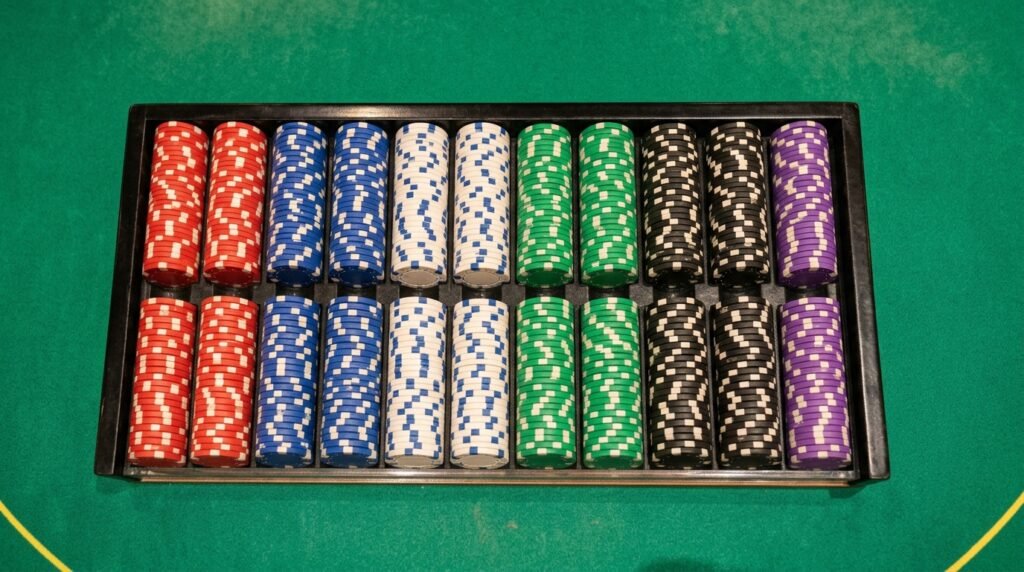
While variations exist, most casinos in the United States follow a general pattern. Here’s how to break it down:
- White or Blue chips — Usually worth $1, often used for low-stakes tables or as the base unit for cash-ins.
- Red chips — Typically valued at $5, among the most commonly used chips on the floor.
- Green chips — Usually worth $25, common at blackjack and roulette tables.
- Black chips — Generally valued at $100, frequently used at higher-limit tables.
- Purple or Lavender chips — Often worth $500, seen less frequently on standard tables.
- Orange chips — Sometimes valued at $1,000, used mainly at high-limit sections.
- Yellow, Gray, or custom-colored chips — Reserved for casino-specific denominations, often $5,000 or higher.
Pro Tip: Always check the small placard at the table or ask the dealer to confirm chip values before you sit down — this single habit prevents nearly every value-related mix-up.
How the Chip System Actually Works Behind the Scenes
Casinos don’t just pick colors randomly. Chip design involves several layered security features that most players never notice.
Each chip typically contains an RFID tag or unique edge-spot pattern that allows the casino to track chip movement, verify authenticity, and detect counterfeits. The color is the visible layer of a much deeper system — one that includes UV-reactive ink, embedded microchips, and casino-specific molds that make replicating chips extremely difficult.
When you exchange cash for chips at the cage, that transaction is logged. The chips themselves become a tracked asset, which is part of why casinos are strict about chips leaving the property or being exchanged between different casinos’ locations.
Dealers are trained to recognize chip stacks by color and height simultaneously, allowing them to process bets and payouts quickly without needing to physically count every individual chip.
Common Beginner Mistakes to Avoid
New casino visitors make a handful of predictable errors when it comes to chip colors:
- Assuming colors are universal. As covered above, this simply isn’t true across all properties.
- Not verifying value before betting. Placing a bet without confirming denomination can lead to unexpected wagers.
- Mixing up chip colors from different casinos. Chips typically only hold value at the casino that issued them.
- Forgetting to cash out before leaving. Chips left in a pocket after a trip are essentially forfeited value if not redeemed.
- Confusing tournament or promotional chips with cash-value chips. These are often the same color family but hold no monetary value outside the specific event.
Casino Chip Terminology Explained
Understanding the language around chips makes the whole system click faster:
- Denomination — The dollar value assigned to a specific chip color.
- Cheque — The formal industry term for what most people call a “chip.”
- Rack — A tray, usually holding 100 or more chips, used by dealers to store and distribute chips at a table.
- Coloring up — The process of exchanging a large number of lower-value chips for fewer, higher-value ones.
- Cage — The cashier area where chips are exchanged for cash.
- Marker — A line of credit extended by the casino, sometimes represented by special chips or plaques.
Pro Tip: If you hear a dealer say “color up,” it simply means consolidating your chips into higher denominations — a normal part of managing a session at the table.
Strategy Tips for Understanding Chip Values Faster
Getting comfortable with chip colors is mostly about pattern recognition and a few deliberate habits:
First, glance at the table placard every time you sit down, even at a casino you’ve visited before — some properties rotate chip designs periodically. Second, practice mentally converting stack heights into totals; most chips are manufactured to a standard thickness, so a stack of 20 is a fairly reliable visual shortcut once you’ve seen it a few times. Third, pay attention to how dealers separate chip colors within their rack — the organization itself is a visual cue for value hierarchy.
Learning the system isn’t about memorizing every casino’s exact palette. It’s about understanding the logic behind the coding, which transfers well even when specific colors differ.
Myths vs. Facts About Casino Chip Colors
| Myth | Fact |
|---|---|
| All casinos use identical chip colors | Colors follow general patterns but vary by property and jurisdiction |
| Chip color has no security purpose | Colors work alongside RFID and UV features for anti-counterfeiting |
| Any casino will redeem any other casino’s chips | Chips are typically redeemable only at the issuing casino |
| Higher chip value always means a bigger physical chip | Size differences exist but aren’t standardized across all casinos |
| Chip colors never change at a single casino | Some properties periodically redesign chips for security reasons |
Comparison Table: Typical Chip Values by Color
| Chip Color | Typical Value | Common Use |
|---|---|---|
| White/Blue | $1 | Low-stakes entry, cash-in base unit |
| Red | $5 | Standard low-limit betting |
| Green | $25 | Mid-limit blackjack, roulette |
| Black | $100 | Higher-limit tables |
| Purple | $500 | High-limit sections |
| Orange | $1,000 | Premium high-limit play |
| Custom (Yellow/Gray) | $5,000+ | Casino-specific, rarely seen on floor |
Conclusion
Understanding casino chip colors meaning comes down to three core ideas: the color system represents value, that system isn’t universal across every property, and dedicated security features work behind each color to prevent fraud. Once you internalize the general pattern — white or blue for low denominations scaling up to black, purple, and beyond — reading any table becomes far more intuitive.
Next time you’re near a table, take a moment to glance at the chip placard and see how quickly you can identify each denomination. Curious about what happens at the table itself? A guide on table layouts and betting areas might be your natural next read.
After all, the chips are just the vocabulary — the table is where you’ll actually learn to speak the language.
FAQs
What color chip is worth the most in a casino?
The highest-value chips vary by casino, but colors like orange, yellow, or custom-designed chips often represent $1,000 or more. Some casinos create unique colors specifically for their highest denominations, reserved for high-limit rooms and rarely seen circulating on a standard casino floor.
Are casino chip colors the same everywhere?
No. While casino chip colors meaning follows general patterns in many regions — like red for $5 and black for $100 — individual casinos can customize their palettes. It’s always best to check the table placard or ask a dealer to confirm exact values before betting.
Can I use chips from one casino at another casino?
Generally, no. Casino chips are typically redeemable only at the property that issued them. Some casinos under the same parent company may honor each other’s chips, but this isn’t guaranteed, so it’s safest to cash out before leaving.
What does “coloring up” mean at a casino table?
“Coloring up” describes exchanging many lower-denomination chips for fewer higher-value ones. This typically happens when: 1) you’re leaving a table with a large stack, 2) the dealer suggests consolidation for easier handling, or 3) you’re moving to a higher-limit table.
Why do casinos use different chip colors instead of just printing numbers?
Color coding allows dealers and pit staff to identify values instantly without reading text, which speeds up gameplay significantly. It also adds a layer of security, since color patterns work alongside embedded RFID tags and UV markings to prevent counterfeiting.
What is the standard casino chip colors meaning for beginners to remember first?
Beginners should start with the most common pattern: white or blue for $1, red for $5, green for $25, and black for $100. These four colors cover the vast majority of standard betting situations you’ll encounter at typical table limits.