






Quick Answer: A straight is five cards in consecutive numerical order, regardless of suit — like 5-6-7-8-9. It’s called a “straight” because the cards run in an unbroken sequence, similar to a straight line. In poker hand rankings, a straight beats three of a kind but loses to a flush.
Ever won a hand and heard the dealer call it a “straight” without really knowing what made it one? You’re not alone. Many beginners glance at their cards, see numbers lined up in order, and wonder why is my poker hand called a straight instead of something else entirely.
The answer is simpler than it looks, but the confusion makes sense. Poker terminology borrows from old card game traditions, and the naming logic isn’t always obvious at first glance. By the end of this guide, you’ll understand exactly what qualifies as a straight, how it compares to other hands, common mistakes beginners make when identifying one, and the terminology that surrounds it.
What Is a Straight and Why Do Beginners Struggle With It?
A straight is one of the ten standard poker hand rankings. It consists of five cards in sequential rank — meaning each card’s number or face value follows the one before it — but the suits don’t matter. You could have a straight made entirely of different suits, and it still counts.
The confusion usually starts here: new players often assume suits play a role, since so many other hands (like flushes) depend on matching suits. A straight is purely about order, not color or symbol. That distinction trips up a lot of people during their first few sessions.
Another common source of confusion is the ace. The ace can act as either the highest card (above a king) or the lowest card (below a two), depending on the sequence. This flexibility is useful, but it’s also where many beginners misjudge whether their hand actually qualifies.
How the Straight Ranking Works (Step-by-Step)
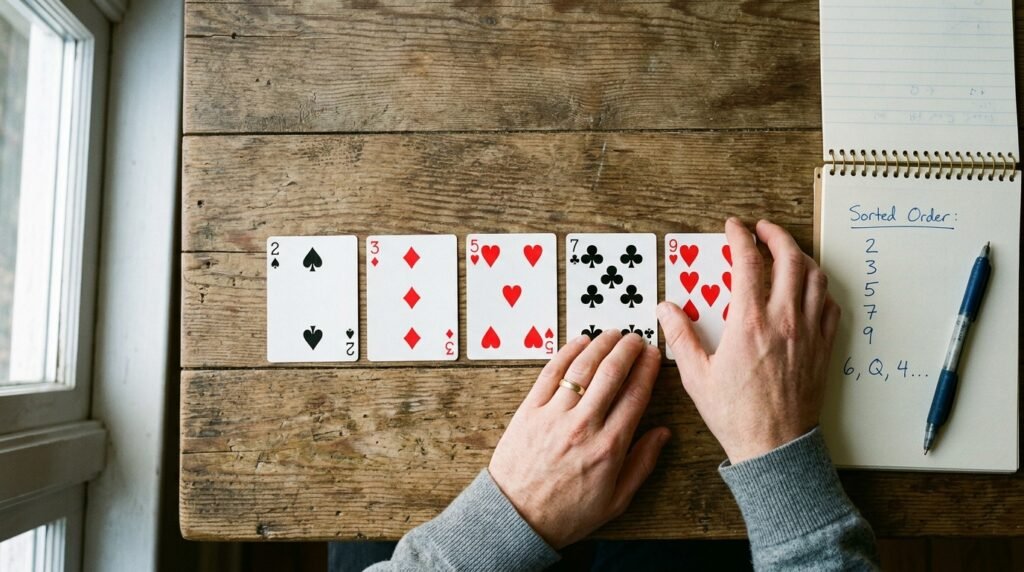
Understanding why a hand counts as a straight becomes much easier when you break it down into steps.
- Collect five cards from your hand and the community cards (in games like Texas Hold’em) or from your dealt hand (in draw poker variants).
- Arrange them in numerical order from lowest to highest.
- Check for consecutive values — each card should be exactly one rank higher than the last, with no gaps.
- Confirm suits are irrelevant — a mix of hearts, spades, clubs, and diamonds is completely fine.
- Account for the ace’s dual role — it can complete a low straight (A-2-3-4-5) or a high straight (10-J-Q-K-A).
- Rule out wraparounds — a sequence like Q-K-A-2-3 is not valid, since the order cannot loop past the ace.
Once all five cards line up this way, you officially have a straight.
The Mechanics Behind Why It’s Called a “Straight”
The name itself reflects exactly what the hand looks like on paper — or on a table. When you lay five sequential cards side by side, they form an unbroken, linear progression, much like a straight line on a number chart. This visual and logical straightness is the origin of the term.
Historically, card game terminology often described hands based on their appearance or pattern. A “flush” refers to cards flushed together by suit. A “straight” refers to cards running straight through consecutive numbers. The naming convention isn’t arbitrary — it’s descriptive shorthand that made hands easier to identify and communicate at the table, long before formal rulebooks standardized poker terms.
Pro Tip: A helpful way to remember the concept is to picture a staircase — each card is one step higher than the last, with no missing steps in between.
Common Beginner Mistakes When Identifying a Straight
Even experienced players occasionally second-guess a straight. Beginners, however, tend to make a few recurring errors:
- Assuming suits matter — they don’t, unless you’re also chasing a straight flush.
- Misusing the ace — trying to use it in the middle of a sequence, like 3-4-A-6-7, which isn’t valid.
- Overlooking gaps — mistaking a hand like 4-5-7-8-9 for a straight when there’s a missing 6.
- Confusing a straight with a straight draw — having four sequential cards and needing one more to complete it doesn’t count as a straight yet.
- Forgetting community cards — in games like Hold’em, players sometimes miss that shared cards on the board complete their straight.
Key Terminology Around Straights
Understanding the language around this hand makes the whole concept click faster.
- Broadway straight — the highest possible straight: 10-J-Q-K-A.
- Wheel (or bicycle) — the lowest possible straight: A-2-3-4-5.
- Open-ended straight draw — four consecutive cards that could complete a straight from either end.
- Gutshot draw — four cards missing one specific rank in the middle to complete the straight.
- Straight flush — a straight where all five cards also share the same suit, a much rarer and stronger hand.
Knowing these terms helps you follow along during hands and understand strategy discussions without feeling lost.
Understanding the Logic: Strategy Tips for Recognizing Straights Faster
Recognizing a straight quickly — without hesitating or second-guessing — comes down to practice and pattern recognition rather than luck.
Start by mentally sorting your cards by number every time, regardless of suit. This habit alone eliminates most errors. Next, pay attention to “connector” cards, meaning cards that are close in rank, since these are the building blocks of potential straights. When playing community card games, always cross-reference your hand with the shared cards to see if a sequence forms across both.
Pro Tip: Practicing with a simple deck at home — sorting cards by number instead of suit — trains your brain to spot straights almost instantly during real hands.
Over time, this kind of repetition builds the same instinct experienced players rely on, where recognizing a straight becomes automatic rather than a manual counting exercise.
Myths vs. Facts About Straights
| Myth | Fact |
|---|---|
| Suits affect whether a hand is a straight | Suits are irrelevant unless it’s also a flush |
| The ace can be used in the middle of a sequence | The ace only works at the very top or very bottom |
| A four-card sequence still counts as a straight | You need exactly five consecutive cards |
| All straights are equally rare | Straights vary in rarity depending on which cards complete them |
| A straight always beats a flush | A flush actually outranks a straight |
Straight vs. Other Poker Hands: Comparison Table
| Hand Type | Requirement | Suit Dependent? | Rank vs. Straight |
|---|---|---|---|
| Straight | 5 consecutive ranks | No | — |
| Flush | 5 cards, same suit | Yes | Beats a straight |
| Three of a Kind | 3 cards, same rank | No | Loses to a straight |
| Full House | 3 of a kind + a pair | No | Beats a straight |
| Straight Flush | 5 consecutive ranks, same suit | Yes | Beats a straight |
Wrapping It Up
By now, the mystery behind why is my poker hand called a straight should be fully cleared up. The name comes from the simple visual and logical pattern of five cards running in an unbroken numerical sequence, regardless of suit. Remember these three essentials: suits don’t matter, the ace can only sit at the top or bottom of the sequence, and gaps in rank disqualify the hand entirely.
Understanding this hand is a small but important step toward reading the game with more confidence. Next time you glance at your cards, will you spot a straight before the dealer even announces it?
If you’re ready to go deeper, consider exploring how straights compare to flushes and full houses in more detail — it’s the natural next step in mastering poker hand rankings.
FAQs
Why is my poker hand called a straight if the suits are different?
The name refers to the numerical sequence of the cards, not their suits. As long as five cards run consecutively — like 6-7-8-9-10 — it qualifies as a straight, even if every card is a different suit. The “straight” terminology describes the unbroken order of ranks, which is the defining feature of this hand.
Can an ace be used in the middle of a straight?
The ace can only function as the highest card (above a king) or the lowest card (below a two). A sequence like Q-K-A-2-3 is not valid because it would require the ace to “wrap around,” which poker rules don’t permit. This is one of the most common points of confusion for new players.
What is the lowest possible straight called?
The lowest straight, A-2-3-4-5, is commonly called a “wheel” or “bicycle.” Here, the ace acts as a low card rather than a high one. It’s still a fully valid straight and ranks the same as any other straight in terms of hand category, though the highest card in the sequence determines its strength against another straight.
Does a straight beat a flush?
No, a flush outranks a straight in standard poker hand rankings. The order from weakest to strongest generally goes: high card, pair, two pair, three of a kind, straight, flush, full house, four of a kind, straight flush. This ranking exists because flushes are statistically rarer than straights.
How many types of straights are there?
There are technically ten possible straights in a standard 52-card deck, ranging from the wheel (A-2-3-4-5) to the Broadway straight (10-J-Q-K-A). Here’s a quick way to think about it:
- Low straights (starting with the ace as a low card)
- Middle straights (various five-card runs)
- The Broadway straight (the highest-ranking version)
What’s the difference between a straight and a straight draw?
A straight is a completed hand with all five consecutive cards already in place. A straight draw means you have four of the five cards needed and are still waiting on one more to complete the sequence. Until that final card appears, the hand doesn’t count as a straight and holds no ranking value yet.