






Quick Answer: Betting always on black in roulette gives you roughly a 47.4% chance of winning each spin (European wheel) or 47.37% (American wheel). The color doesn’t change your odds — red and black are always identical. The house edge stays fixed regardless of pattern or streak.
Introduction
Walk into any casino and you’ll spot someone doing it: stacking chips on black, spin after spin, convinced the pattern will pay off. The phrase always bet on black has become shorthand for a whole philosophy of roulette play — but does it hold up mathematically, or is it just a comforting story gamblers tell themselves?
If you’ve ever wondered whether sticking to one color gives you better odds, worse odds, or exactly the same odds as random picks, you’re asking the right question. In this guide, you’ll learn how the black bet actually works, what the true probability is, why the house edge never disappears no matter what color you choose, and the common mental traps that make this strategy feel smarter than it is.
By the end, you’ll understand roulette color betting well enough to explain it to someone else — no guesswork required.
What Is the “Always Bet on Black” Strategy?
The idea is simple on the surface: you place your chips on black every single spin, ignoring what happened before. Some players treat it as a superstition, others as a “system” they believe reduces risk compared to picking numbers or switching colors randomly.
Beginners struggle with this concept for one main reason — they assume repetition changes probability. It doesn’t. Every spin of a roulette wheel is an independent event. The wheel has no memory of the last ten spins, the last hundred, or the last thousand. Black has no more “energy” or “momentum” behind it after five reds in a row than it did before the session started.
This misunderstanding has a name: the gambler’s fallacy — the false belief that past outcomes influence future ones in a random, independent process.
How Roulette Odds Actually Work
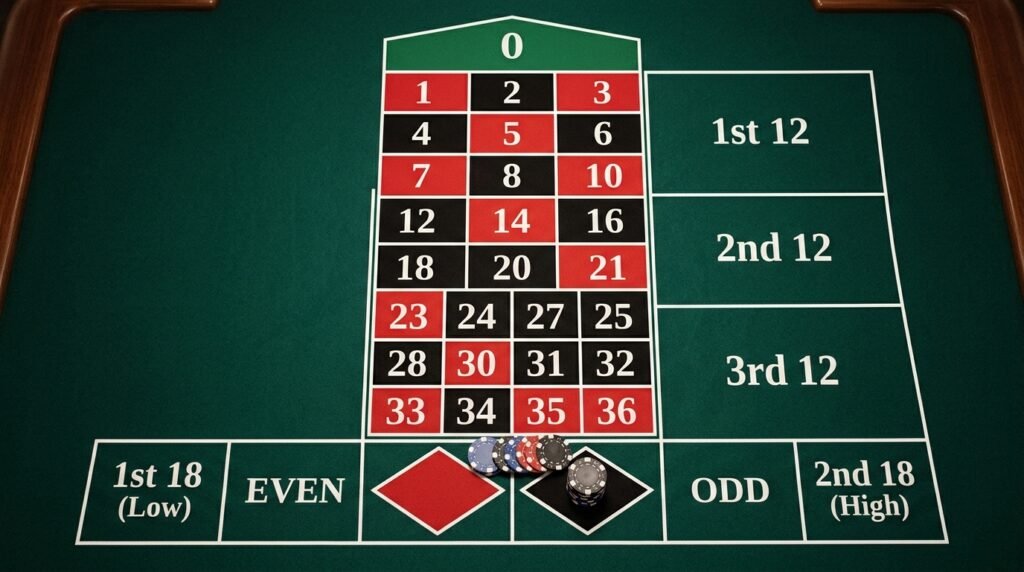
To understand why the strategy doesn’t beat the house, you need to look at the wheel itself.
- A European roulette wheel has 37 pockets: 18 red, 18 black, and 1 green (zero).
- An American roulette wheel has 38 pockets: 18 red, 18 black, and 2 green (zero and double zero).
- Betting on black pays even money (1:1) if a black number hits.
- The green pocket(s) don’t count as black or red — they’re what create the house edge.
- Because the green slot(s) exist, the true odds of hitting black are always slightly under 50%.
That gap between “almost 50%” and “exactly 50%” is where the casino’s advantage lives — and it never closes, no matter how long you play or what pattern you follow.
Pro Tip: The extra green zero on American wheels roughly doubles the house edge compared to European wheels — a detail worth knowing before comparing table types.
The Mechanics Behind Each Spin
Every spin is generated independently, whether by a physical wheel and ball or a certified random number generator online. The ball’s landing pocket isn’t influenced by:
- The color that hit last
- How many times black or red has repeated in a row
- The total amount wagered on either color
- The dealer, the table, or the time of day
This is why tracking streaks on a display board (common at many roulette tables) is entertainment, not a predictive tool. The board only shows history — it doesn’t forecast the next result.
Common Beginner Mistakes With Color Betting
New players tend to fall into a handful of predictable traps:
- Chasing streaks — assuming that after 6 reds, black is “due.”
- Doubling down repeatedly — increasing bet size after a loss, hoping one win recovers everything (a pattern often called the Martingale approach).
- Confusing short-term variance with a real edge — a lucky session doesn’t mean the math has changed.
- Ignoring bankroll limits — treating “the strategy” as a guarantee rather than a coin-flip-adjacent bet.
- Overestimating even-money bets — believing black/red is safer than it statistically is, when in reality it’s simply a different bet type, not a lower-risk one.
Pro Tip: No betting pattern — including always picking one color — can overcome a fixed house edge over the long run. The math is built into the wheel itself.
Key Roulette Terms You Should Know
Understanding the language helps you follow strategy discussions without confusion:
- House Edge — the built-in mathematical advantage the casino holds on every bet type.
- Even-Money Bet — a wager (like black/red, odd/even, high/low) that pays 1:1.
- Outside Bet — bets placed outside the number grid, including color bets.
- Inside Bet — bets placed on specific numbers or small number groups.
- Gambler’s Fallacy — the mistaken belief that independent events are connected.
- Variance — the natural short-term swings in outcomes, separate from long-term probability.
Smarter Ways to Think About Color Betting
Rather than viewing “always bet on black” as a system to beat the house, it’s more useful as a way to understand probability and pattern recognition.
Educational approaches that actually build understanding include:
- Studying payout structures to see how odds and returns relate.
- Learning the difference between independent and dependent probability events.
- Practicing bankroll awareness — treating each bet as a separate decision, not part of a mission to “correct” past losses.
- Recognizing that no wagering pattern changes the wheel’s built-in mathematics.
This mindset shift — from “beating the game” to “understanding the game” — is what separates confident players from those relying on myths.
Myths vs. Facts
| Myth | Fact |
|---|---|
| Black is “due” after several reds in a row | Each spin is independent; past results don’t affect future odds |
| Betting only black lowers the house edge | The house edge is identical for red and black bets |
| Tracking streaks helps predict outcomes | Streak boards show history only, not future probability |
| Doubling bets after a loss guarantees recovery | Bankroll limits and table maximums make guaranteed recovery impossible |
| Online and live wheels behave differently in terms of odds | Both follow the same probability principles when properly regulated |
Comparison Table: Even-Money Bet Types in Roulette
| Bet Type | Payout | European Odds | American Odds |
|---|---|---|---|
| Black or Red | 1:1 | 48.65% | 47.37% |
| Odd or Even | 1:1 | 48.65% | 47.37% |
| High (19–36) or Low (1–18) | 1:1 | 48.65% | 47.37% |
As the table shows, color has no statistical advantage over the other even-money bet categories — they’re mathematically identical in risk profile.
Conclusion
Here’s what matters most: roulette spins are independent events, the house edge exists because of the green zero pocket(s), and no repeated pattern — including always betting black — changes those fixed odds. Understanding this doesn’t make the game less fun; it makes you a more informed player who can separate genuine strategy from comforting myth.
So the next time someone tells you black is “due,” you’ll know exactly why that’s not how probability works. Curious how other even-money bets compare, or how betting progressions like Martingale actually play out mathematically? That’s a natural next stop in understanding roulette strategy.
Sometimes the smartest bet is simply knowing the math behind the wheel.
FAQs
Does always betting on black improve my odds in roulette?
No. Black and red carry identical odds on every spin — roughly 48.65% on a European wheel and 47.37% on an American wheel. The color you choose doesn’t change the underlying probability, since the wheel has no memory of previous outcomes.
Why is there a house edge on color bets?
The house edge comes from the green zero (and double zero on American wheels). These pockets aren’t red or black, so they tip the math slightly in the casino’s favor on every even-money bet, including black.
What’s the gambler’s fallacy in roulette?
It’s the mistaken belief that past spins influence future ones. For example: 1) seeing five reds in a row, 2) assuming black is now more likely, 3) betting heavily on that assumption — when in reality, each spin remains statistically independent.
Is European or American roulette better for color betting?
European wheels have one zero instead of two, giving even-money bets like black slightly better odds (48.65% vs. 47.37%). The rules for color betting itself are otherwise the same.
Can tracking streaks help predict where the ball lands?
No. Streak history boards display past results for entertainment, but they carry no predictive value for future spins, since roulette outcomes are independent events.
Is “always bet on black” considered a real strategy?
It’s better understood as a betting pattern rather than a mathematical strategy. It doesn’t lower the house edge or improve long-term odds — its main value is simplicity, not statistical advantage.